CHAPTER ONE
ZEPHANIAH THOMAS ROBERTS, HIS BROTHERS AND SISTER
ZEPHANIAH THOMAS ROBERTS
EARLY LIFE
My grandfather, born in Monroe Co, GA on July 17, 1882, grew up while living and working on his father's farms. His father John Arthur Roberts and his mother Martha (Mattie) Malinda Simmons Roberts both grew up in Monroe County. They raised four boys and a girl with Zeppie (his childhood name per 1900 census) being the third child. His parents moved a few miles to the northeast in 1896 to a farm located in Jasper County about one and one half miles west of the town of Monticello. Young Zeppie completed only five years22 of school, probably because his father needed him to work on the family farm. My grandfather was taller than the average man born in the late 1800's, thinly built, with dark hair, which turned salt and pepper later in life. In 1918 at the age of thirty-
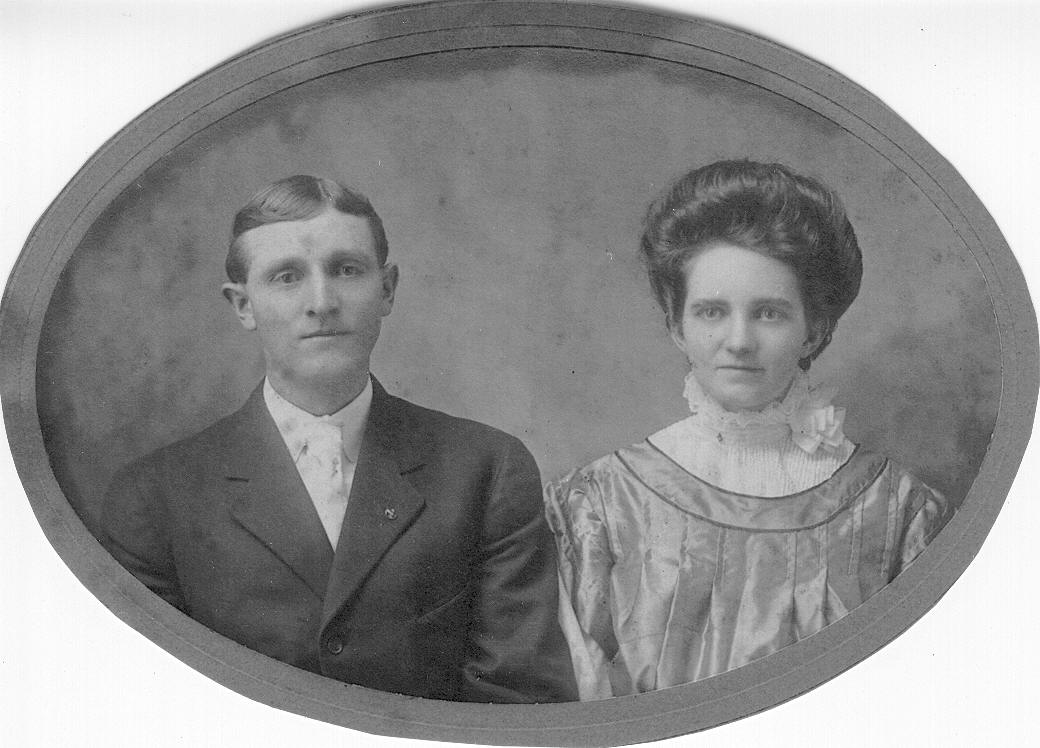
Zephaniah and Bessie Roberts taken about 1910
six his World War I draft registration card listed him as tall and slender with gray eyes and sandy colored hair, while in 1942 his Selective Service Registration Certificate listed him as five feet eleven inches in height weighing 157 pounds with blue eyes, gray hair and a sallow complexion.
I do not know how my grandparents met, but they lived within fifteen miles of each other as teenagers and young adults. When they decided to get married like most suitors of the day, young Zephia (his adult name) visited Bessie Simmons’ Aunt Jo and Uncle Dock to ask for her hand in marriage. Because my grandmother lived with her aunt and uncle after her mother died my grandfather thought it proper to ask them for her hand. Aunt Jo and Uncle Dock refused to give their blessing, but my grandfather told them that he and Bessie would marry anyway.22 Her aunt and uncle were very self-centered people and most likely they did not want to lose young Bessie's hard work around their farm. My grandfather resented their refusal the rest of his life.22 After my grandparents married in 1908, they lived and worked on the family farm in Jasper County.
The 1910 Jasper Co, GA census listed him as a farmer, living in a rented home with his wife and one child; the 1920 census with his wife, four oldest children and parents; and the 1930 census with his wife, four youngest children and his 74 year old mother. He valued his home at $2,000 per the 1930 census. His registration cards listed him as a farmer in 1918 and a miller in 1942.
On June 12 and 13, 1919 Monticello Hardware Company put on an 8-16 International Tractor demonstration at the family farm two miles west of town. The tractor sat on four metal wheels (no rubber) and efficiently plowed, disked, smoothed and seeded the field. It could also haul, cut crops and run the thresher, husker and shredder. The tractor ran on kerosene fuel. During World War 1 many of the young men and the best horses/mules left the farm for the war effort. Very few if any farmers in Georgia used tractors at the time, but the need was there to supply food. The manufacturer claimed the tractor could do the work of three teams of mules. I do not know if my grandfather purchased a tractor or not but I would guess not.1
My grandparents grew cotton on their farm and most likely food crops as well. In the late 1910’s and early 1920’s cotton prices sank very low and the farmers had a hard time making any money. When the boll weevil infestation hit in the late 1910’s, a lot of Georgia farmers quit farming and left for jobs in the cities. In fact, the population of Jasper County dropped from around 17,000 in 1920 to only around 8600 in 1930 while Monticello’s population dropped only slightly to around 1600 [1910-20 census]. In 1917 farmers planted 5.7 million acres cotton in Georgia compared to only 1.5 million acres in 2000. In 2000 only 3.0 million acres of Georgia were used as crop farmland. Much of the cotton farmland has been converted to pine forests over the years. In Jasper County in 1911 farmers harvested 32,000 bales of cotton versus only 8472 and 3207 bales in 1920 and 1927 due to the effect of the boil weevil.2 Most likely because of these problems, my grandfather’s converted from cotton sometimes around 1920 to pine trees. He had a crop of trees cut at least once in the 1930’s [Jasper County Deed Books].
He caught the flu, along with his wife and four children in early 1919.3 His illness resulted in a heart problem from which he never fully recovered.22 Because of this problem he likely felt that outdoor farm work was too much for him especially with low cotton prices and the boll weevil. Therefore, in 1921 after his father died, the family, including his mother, left the farm and moved to Monticello. The family sold the farm in 1939 for $1200, $800 less than his father paid for it 1915 [Jasper County Deed Book S p36]. I believe the family lived and worked on this land even before they purchased it.
My grandfather first purchased a three-room frame house on December 16, 1921 in the Washington Park area of Monticello for $346.25 and family moved from the farm to this home. On December 15, 1922 he purchased from the estate of E. H. Jordan a much larger house on Mangam Street for $2000 [Jasper Co. Deed Books W p57 and S p452]. My grandfather carried a mortgage on both houses but soon paid them off. The name of the street was changed to South Steet at some later date. My father sold the house on South Street in January 1969 for $3500 [Deed Book B-11 p362].
His first four children were born on the farm: Evelyn in 1909, Sarah in 1911, Durward in 1915 and Jabus in 1917. His daughter Martha Lois was born in Monticello in 1922.
WORK CAREER AT FARMERS MILLING COMPANY
In August of 1921 Z. T. Roberts and fifteen other men petitioned the Superior Court of Jasper County to incorporate the Farmers Milling Company for a period of twenty years. They petitioned for the right to establish and operate a mill to manufacture and sell flour, meal, feeds, grits and other milling products. The corporation, also, sought the right to buy and sell machines, real estate as well as borrow money, etc. The Capital stock of the corporation consisted of 100 shares with a par value of $100 per share for a total of $10,000 with the right to increase the capital stock at any time to $100,000 by majority vote. On August 8, 1921 the temporary Treasurer J. F. Benton purchased approximately an one half acre lot on Magnum Street from J. G. Tolleson for $750. On September 10, 1921 he transferred, maybe for stock, the land to Farmers Milling Company for $1.00. The owners named my grandfather manager of the flourmill.
By early November my grandfather had the mill, which was maybe 1500 square feet, up and running with the capability to produce sixty barrels of flour a day from local grain
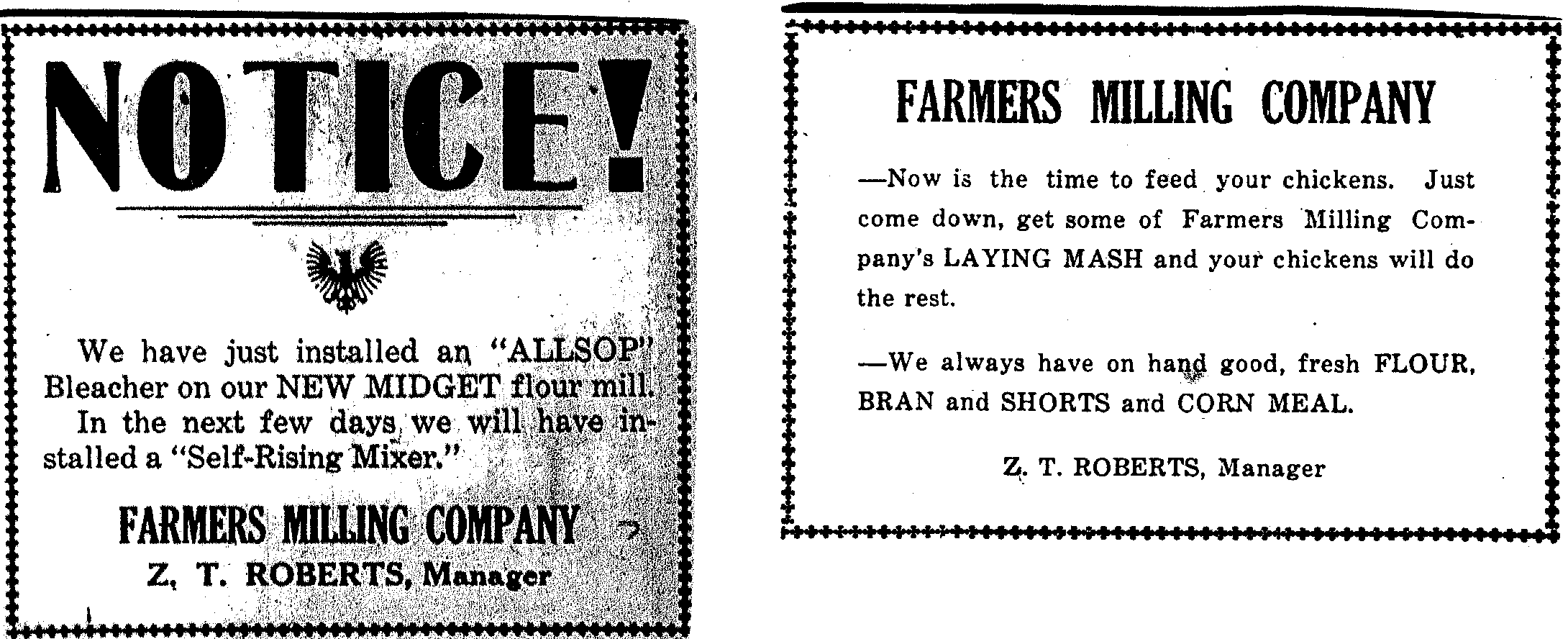
farms. The boll weevil and low cotton prices forced many farmers to switch to growing grains. The mill ground both wheat and corn into flour and meal. Starting in the fall of 1921 advertisements began to appear in the Monticello Newspaper for farmers to bring in
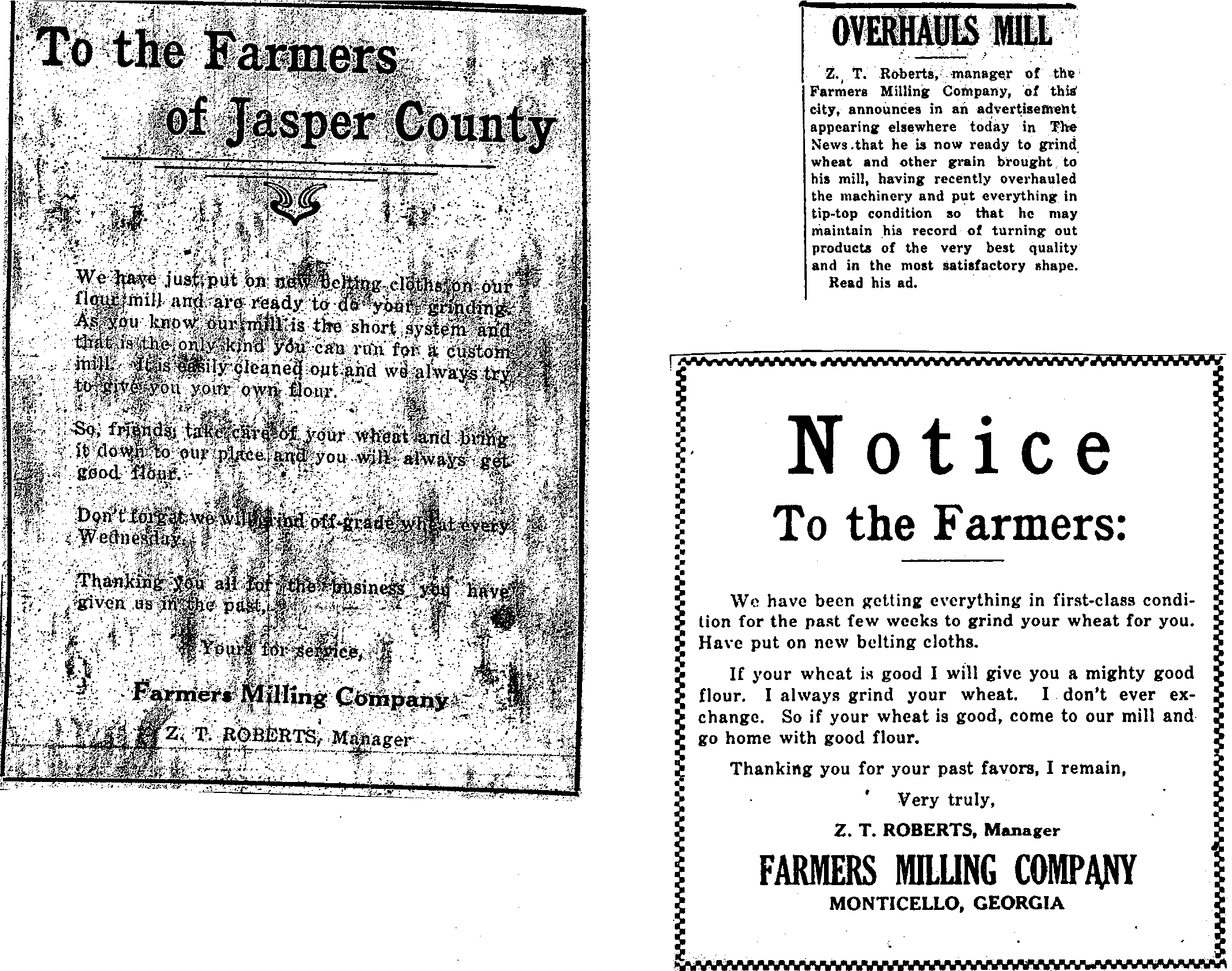
their grains to be customed milled and for local citizens to purchase grains for home consumption and/or feeds for their chickens. Some of the ads are on the next page. Examination of these and other such advertisements indicated that he knew the value of promotion and the need to have a sense of humor. The company soon upgraded the mill with the installation of an Allsop bleacher and a new Midget flourmill. A worker could clean the Midget mill easily and, therefore, it could be used to custom grind wheat
or other grains into flour for the local citizens. Many times my grandfather would grind a customer’s grain and rather than take money he would take a portion of the flour as payment. He could then sell the left over flour. During the summer he often worked 12 to 15 hours a day to meet his customers needs. Farmers Milling Company was located just across the road and down a hundred yards or so from his home; therefore, he went home almost every day for lunch. Often he would take his customers, who were waiting for their grain to be ground, home for lunch as well.
Sometime after 1921 the owners, also, named my grandfather secretary and treasurer of the corporation in addition to his job as manager of the mill. In May of 1937 the stockholders of the company met and by a two-thirds vote adopted a resolution to
Monticello News in June 1922 and February 1924
Monticello News June 1929 and June 1931
surrender the charter of the corporation. The corporation had no debt. On June 10, 1937 the owners changed the name of the company and formed a limited partnership with the new name Jasper Milling Company. My grandfather served again as secretary/treasurer of the partnership as well as manager of the mill until his death in 1944.4,22 [Jasper Co Deed Book S p398 and 403, A-11 p 519-21; Jasper Co Charter Records 1902 - 1947 p 138-40, 213-16].
His daughter Martha said the maximum salary that he took from the mill was around $90 per month. In 1947/8 the mill burned after being struck by lightening during an intense thunderstorm, and in January 1952 the partnership was dissolved and the land was sold for $5,150 to E. C. Kelly, Jr. As a child I can remember the remains of the small mill in an overgrown yard. The family was fairly prosperous even during the depression because of the hard work of my grandfather and his being in the food business.
CIVIC AND COMMUNITY ACTIVITIES
Like most people in the south during the 1920's my grandfather was a Democrat. In 1928 he contributed $0.50 and his brother Verner $1.00 to the Democratic party of Georgia to help Alfred Smith in his unsuccessful bid to be elected president.5
In addition to his work during the 20's - 40's, my grandfather served on the grand jury, on committees appointed by the grand jury, as a Mason, on the Monticello City Council, and as a Deacon in the Monticello Baptist church. He, also, sang in the church choir.22 He served on a three member committee to inspect the county offices and property, and the members reported their findings to the county grand jury. The Monticello News published the results on 8/28/1930. Part of the article is as follows: "We find the jail in good condition well kept... We recommend the County Commissioners screen four windows to prevent mosquitoes and flies from entering the jail... We find the pauper building in good condition. We find six inmates, three colored and three whites... we find the old stockade, one barn in good condition except some of the roofing blown off. We recommend that the roofing be replaced... Tax collectors office - We find his books correctly kept but find a lot of unpaid taxes. We think the taxpayers should co-orporate with the Tax Collector better..."
He served as a Mason during the 1920's and 1930's. In 1923 and 1925 he held the position of Junior Steward and 1932 as Senior Steward in the Jasper Masonic Lodge number 50, F. & A. M. The Monticello News announced the names of the stewards and the time of the meetings, but never anything about the meetings. During this time period the masons were a secret brotherhood that did a lot of good without seeking any credit.
He won three elections for Monticello City Council and served in 1932, 1933 and 1938. In 1933 the council elected him Chairman of the Street Committee, and he worked on several other committees in each of his three terms [Minutes Monticello City Council 8/4/1932 - 8/7/1947]. Five men served on council during the 1930's with each serving for one year. The city paid each alderman $7.00 and $10.00 per month in 1932 and 1938, respectively. In addition, he ran for a council seat for the years 1931, 1934, 1936, and 1939 but lost. The city held the elections in either November or December of the year before the electors served, and the city reported the results in the Monticello News. While running for a seat in the fall of 1937 and 1938 he had to deal with his brother Will’s murder trials; and, therefore, in 1938 he finished seventh out of seven men running. His daughter Martha said her father was a very blunt man with strong beliefs and, therefore, may have upset some of the voters in Monticello.
I found an article in the Monticello News on November 13, 1930 announcing his candidacy for Councilmen. It reads as follows: "I hereby announce my candidacy for alderman of the City of Monticello. I promise to adhere to the policy that an alderman is a servant of all the people and at all times will work for the interest of the city on these terms. I solicit your support and influence in this race. I am, Cordially yours, Z. T. Roberts."
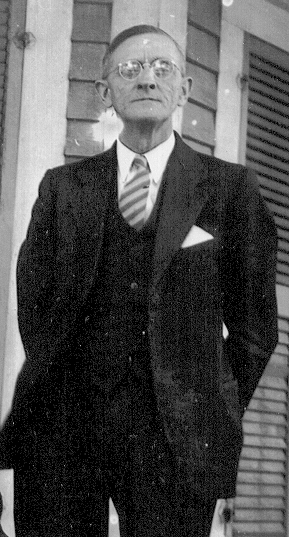
Z. T. Roberts around 1939
PERSONAL CHARACTER, BEHAVIOR AND HEALTH
In first half of the 1900’s in the south, wives served the big meal of the day at noon. My grandfather could be seen rushing home from the mill every work day for a sumptuous lunch served by his wife and then quickly back to the mill. He seemed to always be in a hurry and walked very fast wherever he went, kind of leaning forward as he walked. My grandfather believed in strongly disciplining his children, and he certainly kept a very tight rein on my father while he was growing up. Grandfather Zeph was a strong-willed outspoken man of great integrity with a very strong work ethic, and he spent many hours working at the mill and serving his community. He had little time for small talk or hobbies outside of family, work, church and civic involvement. My father also told me that his father would go to the barber shop in town late every Saturday to get a shave and sometimes a hair cut, so that he would look good for church on Sunday.
Beginning around the age of forty my grandfather suffered from chronic heart disease.22 The heart problem resulted from the flue he caught during the epidemic in early 1919. During the summer when he had to work a lot of hours he would often get sick and should have cut back on his work. One example, in July 1937 the Monticello News
reported that his son Durward came home form school for a month to work at the mill while my grandfather recovered from his illness. Being a proud man it was difficult for
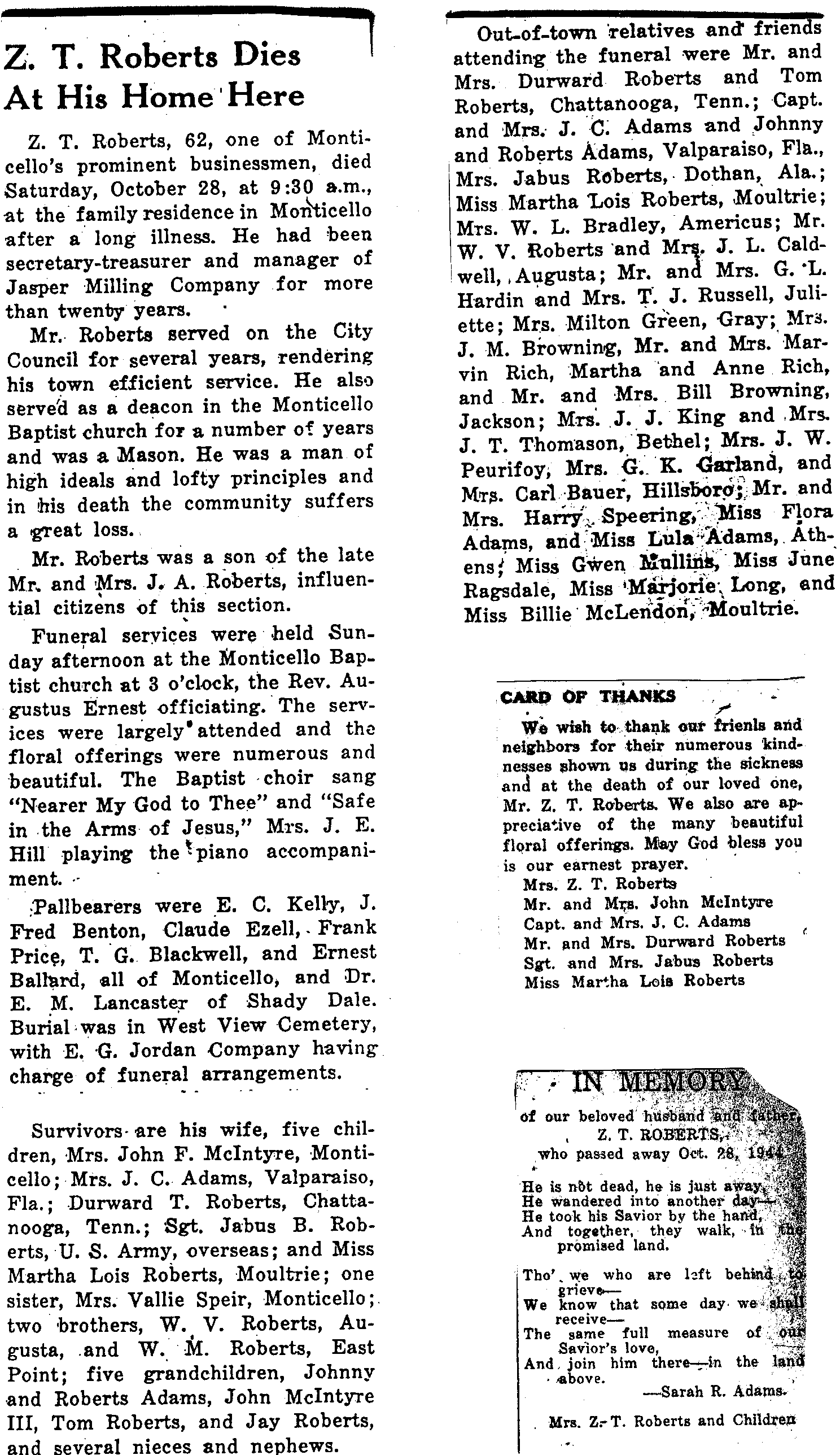
him to cut back on his work when he was sick and even though his doctor told him to get more rest. This extra work may have led to an early death. He died on October 28, 1944 at his home after an extended illness. His death certificate indicated he died from chronic myocarditis, which lasted for twelve months. The Merck Manual 16th edition defines myocarditis as inflammation of the heart muscle usually associated with fever.His will is on file in the Jasper County courthouse in Book 1942-. He left his entire estate (house and around $10,000) to his wife and named his son Durward the executor. The family buried him in West View Cemetery in Monticello, GA. His obituary published in the Monticello News shortly after his death, a card of thanks, and a poem published in the Monticello News November 11, 1946 in his memory and written by his daughter Sarah are on the previous page.
WILEY VERNER ROBERTS
Uncle Verner's first name, sometimes in documents spelled Wylie, came from his grandfather Wiley Roberts, but I have no idea where his middle name, the name he used, came from. Born on November 25, 1875 in Monroe Co, GA he was the oldest son of John Arthur Roberts and Martha (Mattie) Simmons. Around 1896 he moved with his family to Jasper Co, GA. On March 26, 1899 he married Lula Kennon (born September 1877 in Georgia) in Jasper County. They had four children: a daughter Loreena who died as a young child, a daughter Eloise born around 1904, a son Verner Legare born in 1907 in Mansfield, GA and an adopted son Thomas born around 1900. The Jasper Co, GA 1900/1920/1930 censuses listed him living alone/with his wife and two children/wife and son. Since he was already married the 1900 census taker made a mistake. I could not find him listed in the 1910 Georgia census. From at least 1907 through 1913 his family lived in Mansfield, GA a few miles north of Monticello.6 He either traveled to or lived in Michigan or Ohio during 1917, and he spent some time in Toledo and Cincinnati [letters of his brother Jabus Bridges Roberts]. He registered for the World War I draft in Monticello on September 12, 1918, spelled his first name "Wylie" and listed himself as having a medium build and height with light brown eyes and black hair.
In 1920 Uncle Verner owned an automobile business and service station, called Cornwell, Roberts, Oxford Company. On December 6, 1924 he opened a new, so called, first of its kind filling station close to the town square,7 and then on July 18, 1936 he opened a third station called Roberts Filling Station on Greene Street. I believe he closed or sold the older station when he opened the newer one. In November 1936 he sold the last station to a Eugene Allen.8 In November 1934 he ran for Monticello City Council and finished seventh out of eight men running for the five man council.9 During the 1920-30's his family lived around the corner from his brother Zeph.
In January 1937 he and his wife moved to Augusta, GA10 where he purchased and ran a Standard Oil Company service station. His daughter Eloise had earlier married and moved to Augusta but his son Legare spent the rest of his life in Monticello. During the 1950’s I have very fond memories of visiting Uncle Verner (he gave us candy) at his rather old-looking service station in Augusta. He died on June 21, 1967 and was buried at Hillcrest Memorial Park in Augusta.
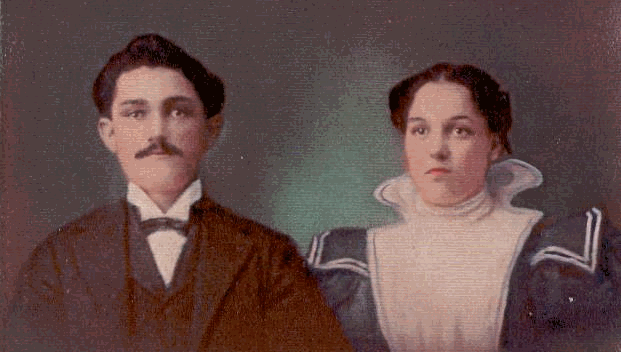
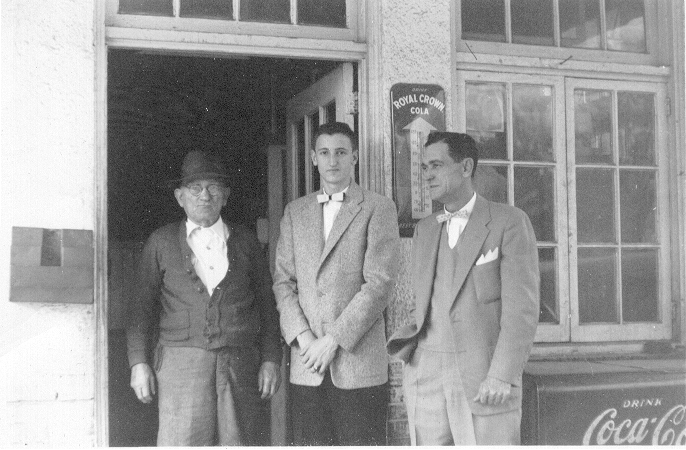
Uncle Verner and his wife Lula around 1899 and at his filling station with grandson Dan and son Legare in the early 1950’s
WILLIAM MARCUS ROBERTS
Will was born on April 16, 1878 in Monroe Co, GA the second son of John Arthur Roberts and Martha (Mattie) Simmons. His middle name came from his grandfather Marcus Simmons, but I have no idea why his parents gave him his first name. Will grew up on his father’s and grandfather’s farm in Monroe County. In 1896 he moved with his family to a farm outside of Monticello, Jasper Co, GA, and around 1901 he married Annie Elizabeth Cole and they had at least seven children (Oscar, Johnnie, Lubie, J. B., Mattie Lou, Rose Elizabeth, and Annie Mildred). According to the 1910/1920 Jasper Co, GA census he lived with his wife Annie and his three/six children in Monticello. In the 1930 census he was listed living with his second wife Katherine and four of his children and one stepson. According to the census records in 1910 Will worked as a watchman in an oil mill, in 1920 as a farmer and in 1930 as a bailiff in Jasper County. In 1930 the family lived in a rented home and paid $10 per month in rent. He registered for the World War I draft on September 12, 1918 in Jasper Co, GA; and his draft card listed him as having a medium build, blue eyes and black hair and his occupation as a farmer. In 1925 the family lived on the Davis Plantation a short distance west of town, where they raised watermelons and cotton.11 During his life he skipped from job to job, and had a major problem with alcohol.
His wife Annie died from pneumonia in January1925, and he married his second wife Katie Hickman Peurifoy on October 24, 1925 in Macon.12 He ran for Jasper County Coroner in March 1928, but lost by a vote of almost two to one.13 In the 1930's he served as a constable in Monticello and his name appeared in several Monticello News papers at least in 1934 on the sale of land or property for past due taxes. A major tragedy happen in his life in November 1931 when his oldest daughter 17 year old Mattie Lou shot and killed herself.14 Maybe Mattie was still depressed from the death of her mother or the alcohol problems of her father. On November 16, 1934 a jury found Will guilty of illegally pointing a gun at another person and fined him $10.00 or three months in jail [Jasper Co, GA Minute Book 8/1934 - 9/14/1940 p37]. For some reason the city allowed him to continue his job as a constable even after this incident.
Katie divorced him on November 8, 1937/ February 14, 1938 (two court appearances). A jury heard the case and voted that both parties were at liberty to marry again [Jasper Co, GA Min. Book 9/1934 - 9/14/1940 p286-7, 311-2].
One day after his first divorce court appearance at around 11:00 P.M. on Tuesday November 9, 1937 Will shot Lubie Perdue five times and killed him on the front porch of the home of C. J. Griggs in Monticello.15 Lubie, a 20 year old boarding at the Griggs’ home, worked as a well driller in Jasper County. Lubie and a friend John Wood spent part of the day drinking at Will Roberts' home. Will's daughters Mildred and Rosa were home at the time and Will came home and had at least one drink with all of them. The two men left Will's home early in the evening. For some reason Will went to the Griggs’ home to confront Lubie and for whatever reason killed him. I can only speculate as to why. Did Lubie proposition one of Will's daughter, did he mouth off in some fashion to Will or the daughters, or did the shooting have anything to do with Will’s divorce the day before? We most likely will never know why Will shot Lubie.
The day after the killing the Jasper County grand jury returned an indictment against Will Roberts for murder. During the two day trial Will Roberts, who was appointed Constable some years earlier, claimed self-defense when he tried to arrest Lubie Perdue for boot-legging. Will claimed that Lubie tried to kill him with a piece of iron or chisel; therefore, Will shot him first in the legs and then in the stomach in self-defense. Will claimed head and hand wounds to prove his testimony. A neighbor said she overheard Will and Lubie talking loud with Will using profanity and Lubie claiming, "I haven't done a thing." No one witnessed the gunshots, but Mr. and Mrs. Griggs drove up to the house just after the shooting. They witnessed Will standing over the body, and claimed they noticed no injuries on him. Sheriff Persons testified that Will smelled of whisky but did not stagger while walking, that he bled over his eye and that the next morning his eye, cheek, forehead and thumb were swollen. Will's daughter Mildred testified that Lubie was intoxicated and used profanity in her presence and that she saw something in Lubie's pocket the size of the chisel.
On November 13, 1937 just four days after the murder, the jury found Will Roberts guilty of voluntary manslaughter and sentenced him to 15 to 20 years in prison. Obviously the jury did not believe his boot legging story, because why would Will have a drink with these men in the afternoon and that evening shoot one of them? For some reason the county retried him and on February 18, 1939 again found him guilty. The jury recommended mercy, but the judge sentenced Will to life imprisonment. The Georgia Supreme Court on October 14, 1939 reviewed the case and ruled: "The evidence supported the verdict, and the general grounds of the motion for a new trial are without merit." The court ordered him to pay a judgment of $190.20 for use of the officers of the court. [Jasper Co, GA Minutes Books 8/1934 - 9/14/1940 p37, 298, 426, 427, 430, 461; 9/15/1940 - 2/1951 p 58, 59, 365; case #12947 GA Archives in Atlanta; GA Supreme Court September Term, 1939 p36].
I do not know how many months or years Will spent in jail, but it must not have been very long because the Monticello News listed him as living in Monticello when his mother died in 1940 and in East Point, GA when his brother Zeph died in the fall of 1944. In 1943 he lived in Fulton County [Jasper Co. Deed Book A-8 p 45]. In addition, he never applied for clemency [GA Archives records], which suggests that he served little or no jail time. According to family members he made life hard for himself because of a problem with alcohol and a poor work ethic. He died in 1952 most likely in East Point, GA and is buried beside his first wife Annie in West View Cemetery in Monticello.
I can only speculate as to why he lived the way he did. Did Katie divorce him because of his drinking or temper problems? Did his problems result from the several tragedies in his life including the death of his first wife and oldest daughter? His behavior must be the reason he seemed to go from job to job during his lifetime. My father occasionally talked about his parents, grandmother, Uncles Verner and Bridges as well as Aunt Vallie but he never mentioned his Uncle Will in front of me.
JABUS BRIDGES ROBERTS
Uncle Bridges was born on July 01, 1894 in Monroe Co, GA the son of John Arthur Roberts and Martha (Mattie) Simmons. In 1896 he moved with his family to a farm outside of Monticello, Jasper Co, GA. According to his World War I draft card and personal letters he sent to his mother he weighed 141 pounds was of medium height and medium build with gray eyes and black hair. I found several pictures of him dressed in his military uniform or a suit. The pictures reveal a very good looking young man who especially liked the company of the young ladies. In 1917 Bridges worked as a dry goods salesman for Benton Supply Company on the square in Monticello. Benton’s was a department store located in a two story building on the south side of the town square.
On April 6, 1917 the United States declared war on Germany, and the government passed a Selective Service Act that required all males between the ages of 21 and 30 to register for the draft. Bridges registered for the World War I draft on June 5, 1917 in Monticello [Registrar’s Report # 10-3-15-A]. On September 1, 1917 the War Department ordered Bridges to report to the Jasper County local board at 3:00 PM on September 6, 1917 for military duty and transportation to the Army mobilization camp at Camp Gordon, Atlanta, GA.16 The army had quickly set up Camp Gordon in 1917 near the present day Dekalb-Peachtree Airport in Dekalb Co, GA a few miles northeast of the Atlanta of 1917. The Army opened the camp for new recruits and trained a total of about 280,000 men there during World War I. After the war the government disposed of the property at public auction.
Bridges spent over seven months at Camp Gordon from September 6 to at least April 17, 1918. During these months he wrote many letters home to his family. A number of the letters survive today in the possession of his nephew William Arthur Speir, Jr. of Augusta, GA. I made copies of most of the letters. These letters reveal a man who was upbeat, polite, ambitious, hard working and very close to his family and community. His penmanship was good, and he could also type. The letters convey only a little about camp life and more about his off camp activities such as frequent trips to Flovilla, GA where he may have had a girl friend named Annie Maddox, his personal feelings and his potential trips home. He returned home as often as he could. On one trip home in March 1918 he caught the mumps so he did not return to camp as planned.17 The letters from Europe (see pages 16 and 17) do tell about some of the conditions in England and France. Most of the letters in existence today were written to his Mamma and none were written to his Papa (I do not believe his father could read).
Upon arriving at Camp Gordon the Army placed him in B Company, 328 Infantry. Bridges lived in a barracks with 23 other soldiers. He distinguished himself during boot camp so much that on October 15, 1917 the captain told Bridges to stay in camp and attend the non-commissioned officers school or as Bridges related to his mother the training camp. Bridges in a letter to his mother "felt honored" at being one of the five chosen from the company of 154. Most new recruits shipped out of camp after a month or two of training, but Bridges stayed for the next training camp. He did not start this training until sometime in January because his entire company was quarantined due to
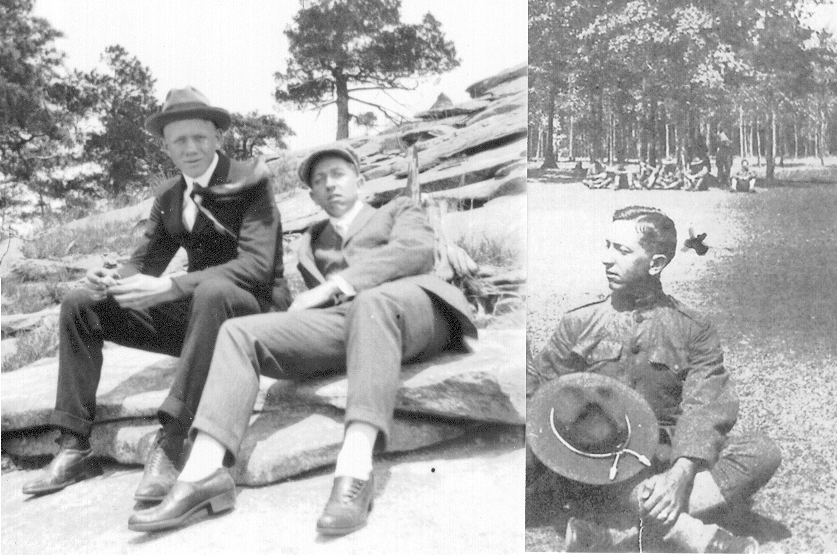
Bridges with most likely his father and at Camp Gordon in 1917 or 1918
some illness, and he was told often to replace the 1st sergeant. He wrote to his mother saying "When they put me in a place to prove what I can do I hate to try and get off….I am sergeant of the guard tonight." On April 17, 1918 he wrote to his mother "don’t know when… it will be several days before I go on duty." In April Bridges graduated from training school as a 2nd Lieutenant and joined the US Army - Company F, 9th Infantry Regiment, 2nd division. It is, also, possible that Bridges was elected lieutenant as officers then could then still be chosen by the men as in the Civil War.
The 9th Infantry started its journey across the Atlantic Ocean from Camp Syracuse in September 1917. The European headquarters for the Infantry resided in Sommerecourt, France. The 9th Infantry soldiers, a part of the American Expeditionary Forces under the command of General John J. Pershing, first engaged in a battle in France against the Germans on March 18, 1918. From March until the end of the war on November 11, 1918 the 9th Infantry lost a total of 584 men killed, 3796 men wounded and 191 men missing in action. In this war men were being slaughtered in numbers much greater than ever before in warfare because of the machine gun, accurate artillery, poison gas, flamethrowers, tanks and airplanes.18
Bridges sailed most likely as part of a convoy from the United States to join the 9th Infantry in late April or early May 1918 and landed in Liverpool, England on May 16, 1918. The ships in a convoy sailed a zigzag course to avoid submarine attack. His unit then traveled across England by rail to Southhampton. From there they crossed the channel arriving in La Havre, France on May 20. In France, Bridges underwent further training, which most likely involved trench digging, marksmanship and exercises under battlefield conditions. After the training Lieutenant Roberts left for the trenches, as a platoon commander, at Roullcourt in support of the front lines on the western front. The western front stretched about 600 miles from the English Channel in the north to Switzerland in the south. The Germans and the Allies both in trenches faced each other across this no-man’s area in between. The line had hardly moved since the early part of the war and millions of men had already died defending it, by the time Bridges arrived.
After about a month in their support role, his platoon traveled to the front lines near Pont-a-Mousson, France, which is about forty miles south of Luxembourg. Lieutenant Roberts did not fight in any of the battles while stationed at Roullcourt or Pont-a-Mousson. He left Pont-a-Mousson for further training. During his training he had time to visit Paris and wrote his Mama on July 27, 1918 describing the beauty of the city. Bridges returned to active duty in mid September for the Champagne drive north of Suippe which is about one hundred miles west of Paris in the Champagne region of France (section of the wars western front).
On September 15th and 16th, the 9th Infantry Regiment marched from Bois d'Heiche to Bois de Rehanne where they camped. The Regiment consisted of 104 officers and 3344 men. Bridges wrote his mother from there on September 18th telling her that he was eating very well but having to live in a small tent during a rainstorm. During September of 1918 this part of France received more than the usual rain, which made life miserable for the soldiers when they had to march from one location to another or sleep in a tent. On the 20th they marched to Toul and there they slept in the barracks. The barracks must have felt wonderful after a long march and sleeping in a soggy damp tent. They trained in Toul until the 29th. His regiment moved once again this time by train to Camp Piemont. The train ride was certainly better than another long march. On October 1, 1918 Bridges again wrote his mother (called her Mother in this letter, but called her Mama in every other letter that I could find) for the last time. The letter "Dear Mother, One token I’m leaving behind before going over. And if my personal belongings never reach you I trust this will. Dearest love, Bridges". He must have known that he might not survive the up-coming battle.
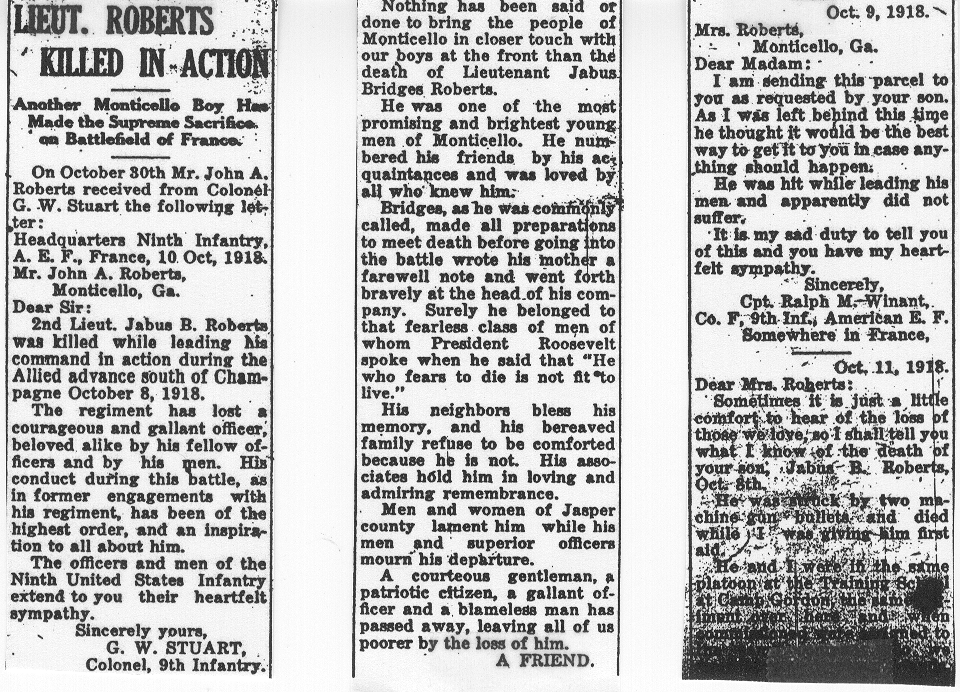
On the evening of October 1 his Regiment started into the Battle of Blanc Mont where the platoon fought for nine days. American and French officers believed that it was absolutely necessary to take the highest point in the rolling Champagne battle area (Blanc Mont) in order to have control of the entire region. The Germans controlled the hill starting in 1914 and fortified it with numerous machine gun nests. During the battle his company F ran into strong opposition. Most of the American infantry troops, including Bridges who were hurled at the Germans, had never had any contact with the enemy. By the morning of October 8, 1918 three of the five officers in Bridges' company were killed or wounded except for him and William A. Powel. Roberts, therefore, took command of the company. Late that afternoon the Germans counter-attacked the left flank of the company. While Bridges moved toward the left flank a machine gun barrage struck him in the abdomen and wrist killing him. He was most likely killed while the infantry was trying to reach the summit where there was very little cover for the Americans and French troops as they attacked the Germans fortified at the top. He died while Lieutenant Powel gave him first aid. Although the losses were heavy for the Americans and the French soldiers, they reached the summit on October 9th and won the entire campaign by October 27. This battle proved to be decisive in our victory in World War I. During this engagement the Regiment lost four officers and 150 men killed, 19 officers and 750 men wounded and 62 men missing in action. On October 10, 1918 the Colonel of the 9th Infantry, G. W. Stuart, wrote John A. Roberts a typed-written letter informing the family of their son’s death during the Allied advance south of Champagne. The colonel indicated "the regiment has lost a courageous and gallant officer, beloved alike by his fellow officers and by his men…of the highest order and an inspiration with his regiment."18,19,20
His body was not mutilated, and the Army buried him in a grave in the commune of St. Etienne-A-Arnes, in the department of the Ardennes one and one-half miles north of Sommepy, France. His body was reburied prior to 1920 in grave number 79, section 17, plot 2, Argonne American Cemetery, Romagne-Sous-Montfaucon, Department of Meuse in France. The cemetery lies within the Zone of the Armies and covers 130 acres where around 14,000 World War 1 solders were buried. After the war his parents made numerous requests to the War Department to have his body exhumed in France and returned to Monticello, GA. His parents first requested his return in 1919 by letter to the War Department. It took many more letters and over two years of effort to have his body returned, due to a restriction the French Government had in place forbidding the removal of the military dead of all nations from the battle area for a period of three years from January 1919. Finally on September 17, 1921 his body was returned to Monticello from France by boat and then by train with an honorary escort for burial. About 75% of the families requested that the bodies of their loved one be returned for burial in the United States. He was finally laid to rest in West View cemetery on Sunday the 18th. Since Lieutenant Roberts showed himself to be such a fine officer, a memorial plaque in his honor is in front of the American Legion Building in Monticello. The plaque mentions
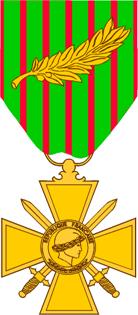
South of Champagne and Chateau Thierry. Bridges, also, received, posthumously, the "Croix de Guerre" for his distinguished military service19 and F Company was cited for its
Croix de Guerre
Article on November 8, 1918 in the Monticello News on Lieut. Roberts
conduct under fire. The French government established the Croix (Cross) in April 1915 to reward individuals for acts of bravery.
I attempted to obtain his military record from the National Personnel Record Center, Military Personnel Records, in St. Louis, but they claimed that fire destroyed his record in 1973
VALLIE ARELIA ROBERTS
Aunt Vallie, named for one of her mother’s sisters, was born on April 16, 1892 in Monroe Co, GA and was the only daughter of John Arthur and Mattie Roberts. She moved with her family to Jasper Co, GA in 1896 and married Joshua Speir around 1911. She and her husband lived in Monticello in 1920 per the census with their two children William Arthur (1924 - 1970) and John Thomas (1919 - 1920). In 1930 per the census she lived with son Arthur in a house, which rented for seven dollars per month. She was not employed at the time. Her husband Josh traveled around Georgia as a salesman. Aunt Vallie found out that Josh had another wife or girl friend in some other city. She filed for and they were divorced on February 2, 1925. The case was held before a jury in Jasper County Superior Court. The jury found that both parties were free to marry again and eleven year old Arthur was awarded to Mrs. Speir [Jasper Co, GA Superior Court Minutes Book 2/1923 - 11/1927 p154,201,202,275,276]. She suffered greatly from the experience and never remarried. After her divorce she lived in a house near the town square, worked part time at Benton Supply Company and helped take care of sick members of her family including her mother and brother Zeph. After World War II she moved to Atlanta and worked as a nurses aid helping older people who wanted to stay home. Sometimes later she returned to Monticello and again lived close to the town square.22 Aunt Vallie was a shy, caring, very nice lady according to her niece Martha Lois and her daughter-in-law Esther. She died in Monticello on December 16, 1968 and was buried in a family plot in West View Cemetery in Monticello.
Submitted for use on this site by Tom Roberts - Thank you Tom!
roberts@plantationcable.net
GO TO CHAPTER 2 OF ROBERTS FAMILY BIOGRAPHY - DURWARD THOMAS ROBERTS
GO TO CHAPTER 3 OF ROBERTS FAMILY BIOGRAPHY - JOHN ARTHUR ROBERTS
Copyright 2009 - by Suzanne Forte for The GAGenWeb Project All Rights Reserved
All Rights Reserved
