By John Harvey
With the creation of our county on December 10, 1807, settlers could officially move into the new county and lay claim to the lands they had drawn in the lottery in November.
As unofficial records indicate, some hardy individuals had been slipping into the territory and setting up homesteads as early as seven to ten years before it was officially opened to settlement.
One of the early official acts in 1808 was the election of officers for the county government. We have undertaken to find the names of these first officers as far as possible. These first officers served five year terms so that when the next state elections were held, the county would be in line with the rest of the state.
The first Board of County Commissioners bought Land Lot no. 56 from Isaac Weldon for the city of Monticello. This lot included roughly, the area inside Julia Street, part of Tanyard on the North, Church Street on the West, the site of the Old Methodist Church on the South and along Green and Frobel Streets on the East. A good part of the lot was divided up and sold to early residents as business and house lots.
William Hitchcock (Hitchcock-Robert House) for example, owned the land from North Warren Street and along East Green to Blue Ruin Street. Records show that he later transferred the part from the present Central of Georgia Railroad tracks to Blue Ruin St to his daughter, Mrs. Norman Powell and Dr. Powell, for one dollar and other considerations. Many think it was probably a wedding present.
The County Commissioners who first served were John Cargile, John Martin, Joseph Carter and Solomon Strickland. The other major county officers were: Clerk of Court, Henry Walker; Sheriff, Patrick Fitzpatrick and Tax Commissioner, William Cargile. These are the ones we are sure of, as we find the others we will pass them on.
The most obvious officers missing is the Probate Judge, as he is called today. This office was first called the Judge of Interior Court until 1851, then from 1851 until 1965 it was known as the Ordinary and since as Judge of Probate Court. Charles Cargile was the first Judge of Superior Court. John Collier, John Gibson and Robert Roby were his clerks, Roby later held the office of judge as did John C. Gibson.
John Collier, who served under the first Judge of Interior Court as his clerk, later moved to DeKalb County when that county was created in the 1820's and served in many county officers. His grandson who was also John Collier became famous in the 1920s and 30s as a U.S. Indian Agent and wrote many authoritative books on Indian life in America.
The sheriff's office also shows some interesting names. Sheriff Fitzpatrick was the first. He was followed in 1813 by Sheriff Robert Owen. Deputies who served under both Sheriffs included William Cook, who was also a practicing attorney. His name often appears as defense attorney in numerous cases after 1815. T. W. Key and Allen McClendon also were listed as deputies. Deputy McClendon was also later to serve as Sheriff on his own.
It is also interesting to note the names of attorneys practicing in the Inferior Court in the beginning years. W. F. Luckie, Joel Flannigan, Own H. Kennan, later a Judge of the Superior Court. Joel Crawford, Eli Shorter, William Cook and one of the most interesting, Timothy Tuck (?).
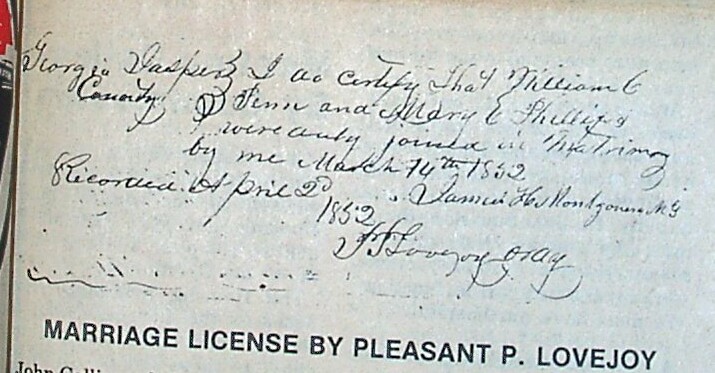
As previously noted the title of the office changed to Ordinary in 1851 and the first elected to the office under that name was Pleasant Pennington Lovejoy. His beautiful Spencerian penmanship makes us realize that something is missing in our modern script.
COPY OF MARRIAGE LICENSE BY PLEASANT P. LOVEJOY WHICH APPEARED IN THIS ARTICLE
Additional Comments:
Transcribed by Suzanne Forte (suzanneforte@bellsouth.net)
April 2005, from copies of articles contained in the Monticello News. There articles were prepared by Mr.
John Harvey and published in this newspaper during the 1970's and 1980's time frame.
Some were under the title "Jasper Reflections", others
"Bicentennial Bits".
Permission has been granted by Mr. Harvey for use of these very valuable and informative articles.
Copies of articles provided by Benny Hawthorne.