|
|
 |
Midway Methodist Church
Lincoln County, GA
|
|
|
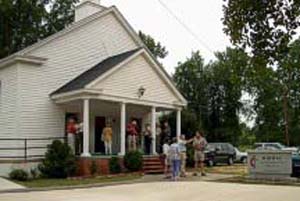
Midway Methodist Church, located about seven miles northwest of Lincolnton, was organized in the summer of 1906. This section had not been served by a Methodist Church since the abandonment of Goshen Church many years before. In the meantime, several Methodist families had moved into the community, and these, along with those who were already attached to this faith, made the field inviting.
Dr. W. A. Burch, E. H. Albea, W. R. Barrett, M. E. Smith, Mrs. T. C. Ward and others invited Rev. A. D. Echols, of the Lincolnton charge, to hold services in the community, with a view of establishing a church. At first, these services were held in the homes, but the interest was so great and the attendance so large, they were transferred to a brush arbor, which had been built for that purpose, on an acre of land donated by R. C. Norman. A church was established and called Midway after the community which was midway between Lincolnton and Danburg.
In the fall of 1906, the present building was erected, though it was not completed until the following year. Mr. Dave Danner of Metasville was hired to supervise the building. The members, the Baptists in the community and those who were not affiliated with any other church, cooperated in the work.
W. A. Burch was made steward, with W. R. Barrett, W. E. Smith and W. A. Burch trustees. Until 1908 the ministers of the Lincolnton charge served this church; during that year it incorporated in the South Lincoln charge, and has been served by the ministers of that circuit since then.
The early years were not easy ones for the infant church. Finances were tight in the farming community and the church needed many things. In 1908, Cleavy Ward purchased an organ for the church, and at times the installments on the organ were less than ten dollars. The first piano was purchased from Julia Powell and was later sold to Ben Smith. After this, the present piano was purchased.
The church has not always been as comfortable as it is now. It was originally heated by a wood burning, pot-bellied stove, with the wood being furnished by the congregation. On especially cold Sundays the congregation would pull their benches close around the heater and have services. Later this stove was replaced by gas space heaters and for a short period, in 1969, the church was air conditioned by window units. Unfortunately, these were stolen after having been in use only a few months, and in the fall of 1972, central heating and air conditioning was installed. Kerosene lamps hung from the side of the walls provided the first lights. Later these were supplemented by an Aladdin Lamp. These lamps were in service until 1941 when electricity was brought into the community.
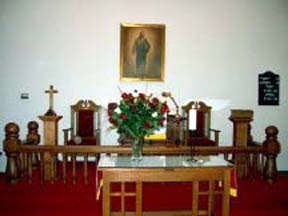
In 1957, the alter was moved forward and three Sunday School rooms were formed directly behind it. 1969 brought the addition of the porch and columns. In 1970, a well was bored and shortly thereafter the pump was stolen. The pump was soon replaced and in 1971 the church annex was constructed containing two new Sunday School rooms, restrooms and a basement social hall. In the fall of 1972, the original pews were replaced by the beautiful new pews now in use.
Though church finances have never been an easy matter, there were times when they were extremely difficult. A copy of the church report for April 3, 1930 shows that after a lesson entitled "Giving Up All For The Kingdom" the collection plate returned empty. The following Sunday the collection increased to five cents and the service closed with the song "Showers of Blessings." During these times when funds were low it was the job of the church trustees to raise the money needed to meet the church's debts. The trustees would go door to door soliciting donations. Often the members did not have cash to give and produce and live chickens were given to the trustees as offerings. These contributions were taken to Lincolnton where they were purchased by Mr. Eugene Reese for resale in his store. The money was then used to pay the pastor. Mrs. Nobie Norman, a former trustee, recalled that at times they were told by a farmer that he was very busy however, if they would gather the corn or some other vegetable themselves, they were welcome to it for his donation. One resident of the community complained about giving a portion of his crops to pay the pastor -- he contended that a man called to preach by the Lord did not want payment for his work. Presently, the collections are supplemented by suppers, bake sales, rummage sales and the generous contributions of former members and friends.
When the church was established, a Sunday School was organized with Alexander Norman Glaze, a Baptist as Superintendent. In the following year T. C. Ward, who had recently been converted and united with this church, succeeded Mr. Glaze. Later, William T. Norman became Superintendent and served in this capacity for many years followed by Thomas Poss.
The present members are very proud of their church and feel truly blessed to have had a part in the advancement of Midway Church, and extend its hospitality to each of you with the hope that you will come to be with them often.