


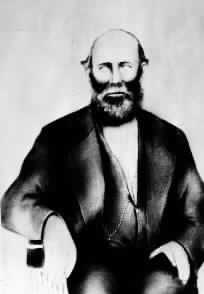
 Capt.
James D. Green, a pioneer settler of Hillsborough and Manatee counties,
was a controversial figure in the Civil War and Reconstruction era in
South Florida.
Capt.
James D. Green, a pioneer settler of Hillsborough and Manatee counties,
was a controversial figure in the Civil War and Reconstruction era in
South Florida.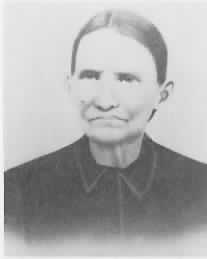
In late 1864, Capt. Green's military service abruptly ended with arrest
and confinement after he and Lt. McCullough filed charges against
officers, including, Capt. J. W. Childs, during whose command Green
charged occurred "gross corruption and mock marriages were celebrated,
gambling encouraged, beef cattel driven in and sold for the benefit of
the officers, the Refugees deprived of their rations, and supplied with
unwholesome flour"; the quarter master of the post Capt. Ames "kept a
harlot in the commissary, sold hides for his own benefit and shared in
the fraud of the Ration Department;" the surgeon of the post Dr. Carroll
"neglected the Refugee families in their sickness nor allow other
doctors to attend them."(17)
Capt. Green and Lt. McCullough were
placed under arrest; the former for fifty days, the latter forty days.
After agreeing to a compromise, Lt. McCullough was released and returned
to command. After a board hearing failed to resolve Green's case,
General Newton (who had succeeded General Woodbury), after he learned
that Green had only a provisional commission and had never been
mustered, ordered the revocation of Green's commission, which was done.
General Newton further ordered that Capt. Doyle of the 110th New York
Regt. relieve Capt. Childs of the command of Fort Myers and gave him
instructions to arrange a compromise between Green and Childs, but
Green, wanting an official investigation, refused.(18)
On
February 15, 1865, the Condederates, led by Major William Footman,
attacked Fort Myers, but were repulsed. Capt. Doyle reported: "Mr. J. D.
Green, formerly connected with the Second Florida Cavalry, took his
rifle and went into the ranks, and from his actions I have every reason
to believe him to be a loyal man.(19)
At Cedar Keys on April 15, 1865, he appealed to the
President and the Secretary of War. In June 1865, statements were
secured from five officers in answer to Capt. Green's appeal for redress
of grievances. Capt. Crane, one of the five, charged that Green was a
disloyal man and a traitor, with all representing Green to be a man of
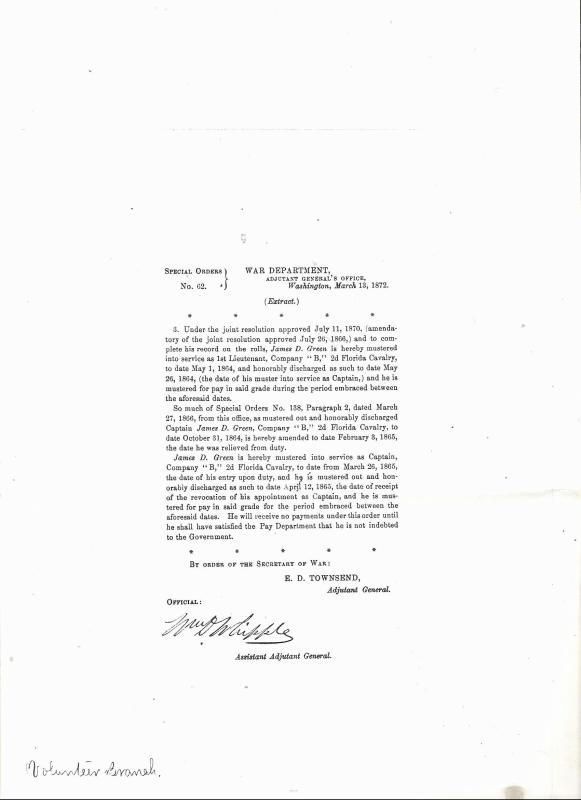
bad character. Nevertheless, Capt. Green was successful for on March 27,
1866 and March 13, 1872 the War Department approved his service as 1st
Lieutenant, Company B, 2d Florida Cavalry to date May 1 to 26, 1864, and
as Captain, Company B, May 26, 1864 to February 3, 1865 and March 26,
1865 to April 12, 1865.(20)
Following the Civil War, Capt. Green,
now a member of the Republican Party, became a powerful political leader
in Manatee County, with his influence reaching into surrounding
counties, Tallahassee, and even Washington, D. C.
James D. Green
represented Manatee County in the October 1865 state constitutional
convention and in the State Assembly (House of Representatives) in the
sessions of 1865 (he resigned in the summer of 1866 and was succeeded in
October by his brother-in-law John W. Whidden, a former Confederate
officer), 1868, 1869, and 1870. From Pine Level, to which he had moved
and in 1866 had helped to make the county seat, the Unionist Green
exercised a powerful sway in South Florida by recommending county office
holders to the governor, who, under the constitution, held the power of
appointment. He was further an agent of the Freedmen's Bureau.(21)
On November 3, 1868, the Legislature met in convention at Tallahasee
to appoint the presidential electors, given to Ulysses S. Grant.
Representative Green was named as the messenger to carry the results to
Washington, D. C.(22)
Geen's most radical act while serving as
Manatee's Representative was his efforts to impeach Governor Harrison
Reed. In the special legislative session in November 1868 H. S. Harmon
(black), James D. Green, and Marcellus L. Stearns were appointed a
committee to prepare and report articles of impeachment against the
governor. The ensuing resolution was reported to the Senate as though
the governor had been impeached, and Lt. Governor William H. Gleason, an
opponent of the governor, opportunistical- ly interpreted it to mean he
was governor. Governor Reed, however, outmaneuvered his enemies and
successfully had Gleason removed from office as he had not been a
citizen of the state for two years as required by the constitution.(23)
On January 21, 1870, Representative Green introduced a resolution
authorizing a committee of five to be appointed to inquire in to the
acts and doing of Governor Reed. The resolution was adopted and Green,
George P. Raney, John Simpson, H. H. Forward, and William B. White were
appointed the committee by Marcellus L. Stearns Speaker of the Assembly.
On February 4, 1870, with White dissenting, the committee, of which
Green was chairman, recommended Governor Reed be impeached, the charges
mainly being allegations of personal and public financial
irregularities.(24)
The Assembly, however, rejected Green's
report by a 29-21 vote and adopted the minority report against
impeachment by a vote of 27-22. After the investigation closed, Green
called at the executive office and informed the governor of the report
in his favor. Governor Reed and Green, afterwards, reached a mutually
advantageous political truce. (25)
On July 11, 1870 at Pine
Level, Green was nominated as an Independent candidate for state senator
to succeed Henry A. Crane, his former commander. After he, in August,
supported the candidacy of black state senator Josiah Walls of Alachua
County for Congress, the conservative backlash doomed Green at the polls
in November. Via appointment, he served in other offices, e.g., as a
federal deputy marshal, county commissioner, county sheriff, and
postmaster of Pine Level.(26)
When John
F. Bartholf, the Republican clerk of court of Manatee County,
submitted his resignation in late August 1876, Capt. Green in his swan
song proposed to his friend, Republican Governor Marcellus L. Stearns,
also the party's nominee for governor, that his 24-year-old son Andrew
Green be appointed clerk. Named clerk in October,
Andrew, acting in accord with his father's directives, refused to post
bond for the issuance of his commission, leaving no legal clerk for
elections in November, which the Democrats were favored to win handily.
Manatee Democratic leaders proceeded anyway with the November 7
election, sweeping the county with 288 votes for Samuel J. Tilden for
president and 289 votes for George F. Drew for governor. Green, seeing
the handwriting on the wall, had urged Republicans to boycott the
election, and only 26 voted for Republican presidential candidate
Rutherford B. Hayes and Florida gubernatorial nominee Marcellus L.
Stearns. Initially, Governor Stearns, by a 400-majority that excluded
Manatee as the election was invalidated was declared to have carried
Florida, as well as, Hayes by more than 900. Democrats, however,
appealed, and, after much legal maneuvering, the Manatee votes (with
other contested) were counted for Drew, but were excluded for Tilden,
which gave Florida a split ticket of Republican Hayes for president and
Democratic Drew for governor. Drew's margin of victory was only 195
votes. The brokered election of 1876 ended, not only Capt. Green and the
Republicans' state influence, but more significantly, Reconstruction and
the civil rights movement for nearly a century.(27)
Green
continued to live in Pine Level where he farmed and continued to dabble
in local affairs. In 1878, he startled the complacent Democrats when he
attempted unsuccessfully to reclaim his old House seat. In his last
hurrah in February 1880, he tried to revive the Republican Party with a
mass meeting at Pine Level. In 1882, still arousing contention, signing
himself as "Torpedo" and "Ex-Church Member," Green in articles to the
Fort Ogden Herald alienated his
fundamentalist neighbors when he, among other things, criticized a local
minister, Rev. I. J. Sparkman. In 1885, he had a modest farm consisting
of 70 acres, 1 horse, 2 oxen, and 615 cattle.(28)
Capt. James
Dopson Green died April 8, 1886 and was buried in Pine Level Campground
Cemetery.(29)
A newspaper reported:
"Capt. James D. Green
died in Manatee County on April 8. The deceased will be remembered as
one of the men of this State who did so much for the Republican party
from the close of the war up to the overthrow of that party in 1876. No
man ever offered greater resistance to the Democracy in this State than
Capt. Green did in his section. It was through his advice that Stearns
attempted to deprive the people of Manatee county of the right of
suffrage in 1876. He succeeded in having the vote of this county
rejected by the notorious state canvassing board, so as to give the
electoral vote of Florida to Hayes, and to defeat George F. Drew for
Governor. Aided by L. G. Daniels he succeeded in the former but failed
in the latter undertaking. Neither of these staunch and vigorous
partisans were afterwards rewarded by Hayes for their work, and neither
ever afterwards exhibited much interest in the welfare of the 'grand old
party.' Capt. Green was a native of Anderson county, S.C., and was born
in October, 1823. He joined the Union army at Key West at the outbreak
of the war, and was made a captain of infantry. He was seated as a
Republican member of the Legislature from Manatee county in 1872. He was
deputy collector of customs at one time for the port of Manatee. He
leaves a wife, one son and five daughters." [Some details of the
obituary are inaccurate.](30)

On August 9, 1890, Eliza Green of Pine Level under the Act of June
27, 1890 applied for a pension as the widow of James D. Green Capt., Co.
B, 2nd Florida Cavalry. On April 5, 1895 George Mizell, 47 of Pine
Level, gave an affidavit in Eliza's behalf, in which he stated:
"The widow at present resides on a small undivided estate valued on the
tax rolls of the county at 430 dollars. In this she an interest of
one-fifth (1/5). The personal property of said estate is valued at 800
dollars but in this she has no interest as shown by the administrator's
record, having already overdrawn her interest in said personal property.
All this property is assessed in the name of Jas. D. Green Est. The
widow has nothing whatever in her own right and no person is bound for
her support. Her income from all sources as spring 1894 was 80 dollars
and 16 cents." Her claim was approved under certificate no. 468877,
commencing on August 16, 1890 at $8 per month. Eliza W. Green died on
August 8, 1903.(31)
Capt. and Mrs. Green had the following
children:
1. George Green, born ca. 1850; died in 1860s.
2. Andrew
Green, born March 25, 1852; died July 11, 1925, Miami, Fla.; married
on May 22, 1877 Martha E. Mizell.
3. Hugh Green, born ca. 1855; died
in 1870s.
4. Mary Elizabeth Green, born ca. 1857.
5. Helen Jane
Green, born ca. 1859.
6. Leroy Green, born ca. 1860; died in 1870s.
7. Infant, born ca. 1862/63; died 1860s.
8. Karon Green, born ca.
1866; married on June 28, 1887 John W. Myers.
9. John Green, born ca.
1869; adopted.
10. Ada S. Green, born ca. 1870; married on April 10,
1888, W. H. Jenkins.
11. Kate Green, born ca. 1873.(32)
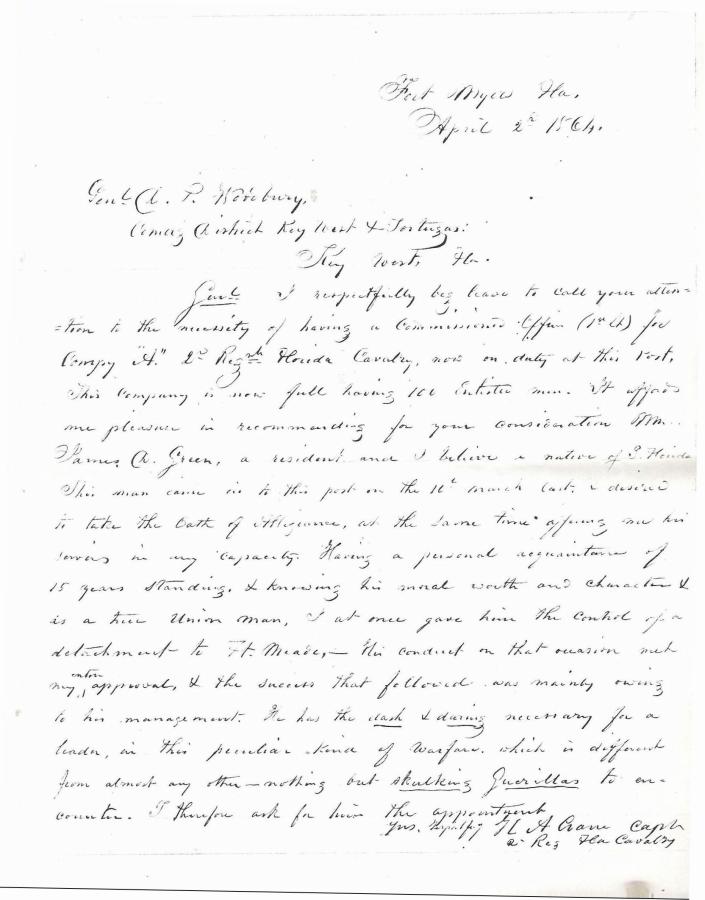
Letter of April 2, 1864
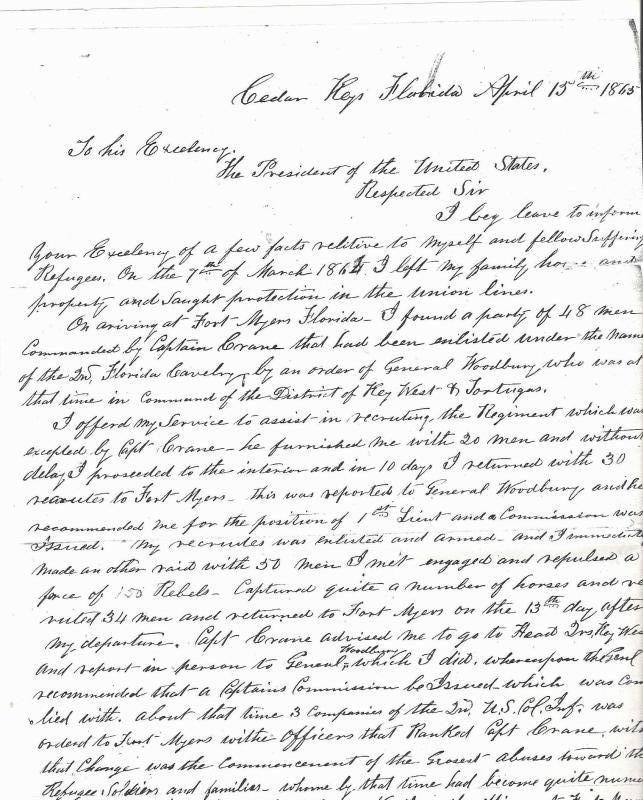
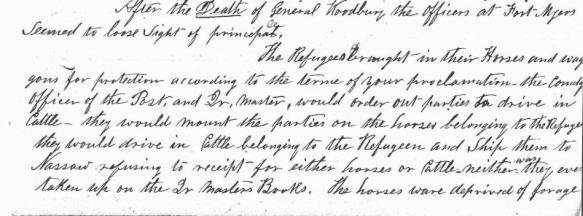
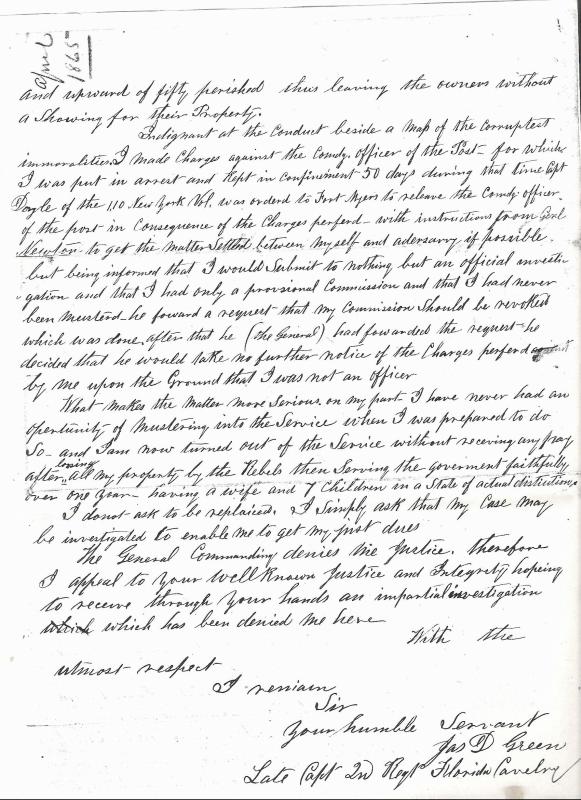
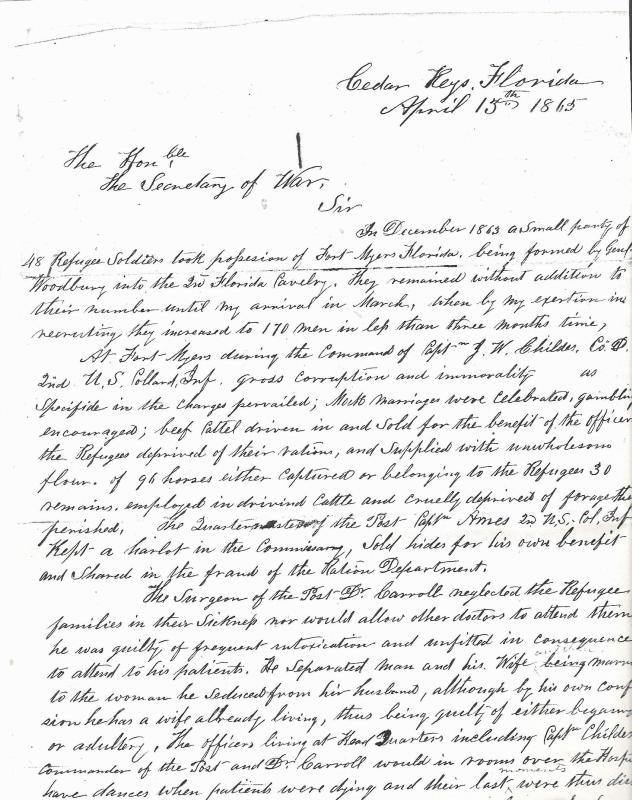
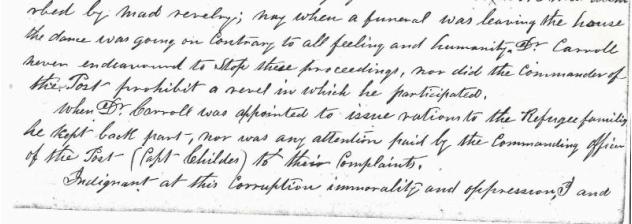
Missing page 6
If you have questions, contributions, or problems with this site, email:
Coordinator -
AVAILABLE FOR ADOPTION
State Coordinator: Paula Perkins
Asst. State Coordinator: Rebecca Maloney
If you have questions or problems with this site, email the County Coordinator. Please to not ask for specfic research on your family. I am unable to do your personal research. I do not live in Indiana and do not have access to additional records.
