John Parker
By Spessard Stone
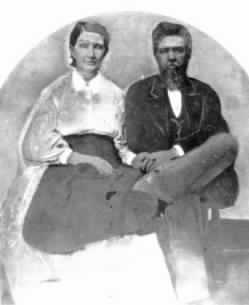 John
Parker, a pioneer settler of South Florida, was an Indian fighter,
cattleman, and civic leader.
John Parker was born October 16, 1818 in Sampson County, North Carolina.
With his parents, Luke and Sophia Parker, he moved about 1831 to that
part of Alachua County, Florida, which on February 4, 1832 became
Columbia County.
During the Second Seminole War, John Parker served as a private from May
22, 1836 to June 5, 1837 in the companies of Captains Martin, Reed, and
Niblack. He also served as a sergeant in Capt. Brown's Company from June
16, 1837 to December 18, 1837.
In Columbia County on December 12, 1839, he married Mrs. Jane Elizabeth
(Smiley) Hooker, born April 9, 1809, widow of Stephen Caswell Hooker
(1808-1837). By the marriage John became the stepfather of William John
Hooker and Stephen
Poleman Hooker,
for whom he was appointed guardian on August 12, 1850.
Under provisions of the Armed Occupation Act of August 1842, John Parker
received permit number 651 for 160 acres in Simmons Hammock (Seffner) in
Hillsborough County, Florida and moved there in 1843. The Parker family
was listed in the Simmons Hammock Settlement in the 1850 census.
John was a cattleman, but he also held several offices of public trust
in Hillsborough County. In 1845, he was elected sheriff and also acted
as ex-officio tax collector. He was a justice of the peace for several
terms. On November 3, 1847, he was elected for a two-year term and
qualified November 30. Again chosen on May 29, 1849, he qualified on
November 19, 1849. His final term of selection was May 25, 1853. On
October 24, 1849, he was elected to the Board of County Commissioners
for a term of two years and qualified November 19, 1849.
On July 17, 1849, Captain
George S. Payne and
Dempsey Whidden were killed and William
and Nancy McCullough were
wounded by a party of Seminoles at the Kennedy-Darling trading post on
the banks of the Charlo-Popka-Hatchee-Chee (Little Trout Eating Creek),
which became later known as Payne's Creek. The post was located about
one half mile south where Fort
Chokonikla was
afterwards established on October 26, 1849, southeast of present-day
Bowling Green.
F.C.M. Boggess in
his autobiography, A
Veteran of Four Wars,"
related his version of the attack and John Parker's reaction to it:
"A man by the name of Payne opened up a store to trade with the Indians.
He had employed Dempsey Whitton (sic) and had employed Wm.
McCullough and
wife to keep house and cook for him.
"The Indians came in and began to drink and Payne refused to let them
have any more whiskey. While at supper they shot a volley killing Payne
and Whitton (sic), McCullough sprang for his shotgun and he and his wife
left. Mrs. McCullough was wounded by the Indians while running and
McCullough would urge her to go ahead. She had a baby one-year old to
carry as McCullough had to fight the Indians back and then rush up to
his wife. The Indians were too cowardly to rush on him and when he could
see one he pointed his gun and the Indian would jump behind a tree. They
followed him some miles and went back to rob and burn the store.
"McCullough and wife had to travel fifty miles with nothing to eat
except birds without salt. He had to carry the baby and gun and lead his
wife. The whole country fled to forts and a party went and took up Payne
and Whidden's bones and buried them. A tombstone now marks the site of
the store and remains of Payne and Whidden. Mrs. McCullough soon
recovered.
"Capt. John Parker, who had been all through the seven years' war with
the Seminoles from 1835 to 1842, at once began to recruit a company to
fight the Indians at his own expense. He mounted and equipped a company
and began to scout for Indians. There is no question but his prompt
action in enlisting and equipping a company and hunting the Indians
prevented a general outbreak and a long and bloody war.
"Capt. Parker was a great Indian fighter and he was always among the
first to respond if any fighting was to be done and he has led several
detachments of volunteers to the relief of the whites that were penned
up in houses or forts."
A deposition given on August 11, 1849 by the McCulloughs at
Tampa differed slightly from Boggess' account. It had the Indians, four
in number, had falsely pretended to want to trade skins which were
across the Peas Creek (Peace River). No mention was made of a demand for
whiskey. The attack at supper had also resulted in Mr. McCullough being
wounded in the left shoulder. (McCullough's wife, Nancy, was a sister of
Dempsey Whidden.)
Billy Bowlegs and Sam Jones, Seminole chiefs, did not want a war. On
October 18, 1849, they surrendered three of the murderers to General
Twiggs. A fourth had attempted to escape and was killed; his severed
hand was turned over to the general as evidence. A fifth had escaped but
was being pursued. (An earlier attack by the band had occurred on July
12, 1849 near Fort Pierce.)
During the Third Seminole War, John Parker served as first lieutenant
from January 3, 1856 to August 20, 1856 in Capt. William
B. Hooker's
Company, Florida Mounted Volunteers. He was enlisted at Fort Meade but
was on detached service at Fort Green for most of his tour. At Manatee
on October 7, 1856, he enlisted as a private in Lt. Whitaker's
Detachment and was, subsequently, on November 18, 1856 elected as
captain of the company, thereafter known as Capt. John Parker's Company.
He was mustered out at Tampa on December 17, 1856.
Capt. Parker was an early cattle king of this area. In Hillsborough
County on April 12, 1852, he registered his mark and brand: swallowfork
in one ear, undersquare in the other, brand "JP." On December 23, 1854
in Hillsborough County, he registered staplefork in one ear, crop and
split in the other, "SS." About 1856, he moved to Manatee County and
settled in the area of present-day Ona. In Manatee County on May 28,
1860, he registered: crop and two splits in one ear, swallowfork and
underbit in the other. In 1855, he had 1,700 head of cattle; 4,000 head
in 1861; and 1,000 head in 1866.
In Manatee County Capt. Parker took an active interest in political
affairs. On January 10, 1859 John Parker, John Platt, and Joab Griffin
were appointed road commissioners and ordered to build a road from
Manatee Village to Horse Creek. On November 22, 1859 John Parker was
selected as a justice of the peace for a two-year term and qualified
February 4, 1860. In April of 1859, he, Daniel
Carlton,
and Enoch Daniel were appointed trustees of Manatee County District No.
3. Capt. Parker represented Manatee County in the Florida House of
Representatives in 1860 and 1861. On May 7, 1860, he was elected
Lieutenant Colonel of the Twentieth Regiment of Florida Militia and was
commissioned by Governor Perry on June 11, 1860. On February 9, 1863,
the Board of County Commissioners appointed John Parker and five others
to a committee to buy and dispense provisions to the wives and children
that were struggling to get by during the time the heads of households
were away at the war.
During the Civil War, Capt. Parker had three members of his family to
serve in the Confederate cause. Lewis H. Parker, son of John Parker,
enlisted April 10, 1862, in Co. E, 7th Florida Infantry and was
honorably discharged June 17, 1862. He subsequently enlisted in Co. B,
9th Florida Infantry, Sept. 21, 1862, (6th Florida Battalion) and was on
detached service driving cattle in Florida since Oct. 8, 1863. William
John Hooker and Stephen Poleman Hooker, his stepsons, both enlisted as
privates in Co. E, 7th Fla. in April 1862. Stephen (who was married to
Sallie Carlton) died January 7, 1863 at Morristown, Tennessee. William
(who was married to Charlotte Albritton) was promoted to 2nd lieutenant
on November 28, 1863 and was later killed in battle.
Kyle VanLandingham related:
"On July 1, 1863, John Parker and Alford Sloan were involved in a deadly
encounter with a Confederate deserter named John Cason. Cason was the
husband of Myantha Gillett, daughter of Daniel and Myantha (Raulerson)
Gillett. He had enlisted in Co. B, 7th Florida Infantry on May 28, 1862,
and was left sick in Loudon, Tennessee, August 1, 1862. The rolls show
that he was absent after that time and was eventually listed as a
deserter. Family members believe that John Cason was furloughed to
return home to Florida 'to protect his cattle from thieves, and was
killed in the woods by the thieves, in Manatee Co., Fla., his body not
being found for several days.' On July 1, 1863, John Parker and Alford
Sloan shot and killed John Cason. Parker shot Cason through the heart
and Sloan shot him from behind in the back of the head. At this time,
John Parker was owner of several thousand head of cattle in Manatee
County.
"After the Civil War, at the Fall Term of the Circuit Court in Manatee
County, November 1866, John Parker and Alford Sloan were indicted for
the murder of John Cason. John H. Hollingsworth and Wells Murphy were
subpoenaed as witnesses. Arrest warrants were issued on Nov. 9, 1866,
and Parker was arrested on Jan. 9, 1867. On that same day, John Parker,
joined by sureties W. H. Addison and John Altman, posted bond in the
amount of $5,000 and Parker was released. Circuit Court records show
that on Nov. 11, 1867, at the Fall Term of Circuit Court, the charge of
murder against John Parker was dismissed on motion of the Solicitor
(prosecuting attorney). A notation on the back of Alford Sloan's arrest
warrant by Sheriff J. J. Addison states that Sloan was released by the
Governor's Proclamation. Florida Gov. David S. Walker had earlier issued
a proclamation of amnesty to all persons who had committed crimes
against the peace of Florida during the Civil War."
After the war, John Parker settled at Homeland in Polk County. In the
1870s, he began disposing of his cattle. During the decade, he sold
3,000 head to his sons, Thomas O. and Jasper N. Parker, and 2,000 head
to his brother, Streaty Parker.
John Parker died on November 10, 1881 at the home of Philip Dzianlyski
at Fort Meade and was buried at Homeland Cemetery. John had been a
member of Bartow Lodge No. 9, F. & A. M. and the Methodist Church. Jane
Parker died on May 1, 1891 at the home of her son, Lewis H. Parker, at
Joshua Creek and was buried at Joshua Creek Cemetery.
According to family tradition, John was murdered
by poison at
the Campground Meeting near Homeland, between Fort Meade and Bartow. He
reportedly received a drink of liquor laced with poison or ate food that
had been poisoned. His body was found in the outhouse, with his feet
sticking out. John's son, Thomas Owen Parker, tracked down and killed
his father's assassin. John Parker's alleged poisoning death was the
culmination of a series of poison attempts against prominent cattle
kings in Southwest Florida.
Issue of John and Jane Parker:
1. Martha J. Parker, born September 22, 1840; died November 17, 1843.
2. Lewis Henry Parker, born May 26, 1842; died March 4, 1901; married on
February 1, 1866, Lydia Elvira Starnes.
3. Louisa Sophia Parker, born June 14, 1844; died October 16, 1906;
married on February 5, 1866, Alexander Smoot Johnston, M. D.
4. Thomas Owen Parker, born May 20, 1846; died May 11, 1918; married on
January 2, 1870 Sarah Louisa Blount.
5. John M. H. "Jack" Parker, born May 28, 1848; died December 28, 1868.
6. Jasper Newton Parker, born April 13, 1851; died August 27, 1896;
married on July 8, 1869, Rhoda Jarrett Crum.
John
Parker, a pioneer settler of South Florida, was an Indian fighter,
cattleman, and civic leader.
John Parker was born October 16, 1818 in Sampson County, North Carolina.
With his parents, Luke and Sophia Parker, he moved about 1831 to that
part of Alachua County, Florida, which on February 4, 1832 became
Columbia County.
During the Second Seminole War, John Parker served as a private from May
22, 1836 to June 5, 1837 in the companies of Captains Martin, Reed, and
Niblack. He also served as a sergeant in Capt. Brown's Company from June
16, 1837 to December 18, 1837.
In Columbia County on December 12, 1839, he married Mrs. Jane Elizabeth
(Smiley) Hooker, born April 9, 1809, widow of Stephen Caswell Hooker
(1808-1837). By the marriage John became the stepfather of William John
Hooker and Stephen
Poleman Hooker,
for whom he was appointed guardian on August 12, 1850.
Under provisions of the Armed Occupation Act of August 1842, John Parker
received permit number 651 for 160 acres in Simmons Hammock (Seffner) in
Hillsborough County, Florida and moved there in 1843. The Parker family
was listed in the Simmons Hammock Settlement in the 1850 census.
John was a cattleman, but he also held several offices of public trust
in Hillsborough County. In 1845, he was elected sheriff and also acted
as ex-officio tax collector. He was a justice of the peace for several
terms. On November 3, 1847, he was elected for a two-year term and
qualified November 30. Again chosen on May 29, 1849, he qualified on
November 19, 1849. His final term of selection was May 25, 1853. On
October 24, 1849, he was elected to the Board of County Commissioners
for a term of two years and qualified November 19, 1849.
On July 17, 1849, Captain
George S. Payne and
Dempsey Whidden were killed and William
and Nancy McCullough were
wounded by a party of Seminoles at the Kennedy-Darling trading post on
the banks of the Charlo-Popka-Hatchee-Chee (Little Trout Eating Creek),
which became later known as Payne's Creek. The post was located about
one half mile south where Fort
Chokonikla was
afterwards established on October 26, 1849, southeast of present-day
Bowling Green.
F.C.M. Boggess in
his autobiography, A
Veteran of Four Wars,"
related his version of the attack and John Parker's reaction to it:
"A man by the name of Payne opened up a store to trade with the Indians.
He had employed Dempsey Whitton (sic) and had employed Wm.
McCullough and
wife to keep house and cook for him.
"The Indians came in and began to drink and Payne refused to let them
have any more whiskey. While at supper they shot a volley killing Payne
and Whitton (sic), McCullough sprang for his shotgun and he and his wife
left. Mrs. McCullough was wounded by the Indians while running and
McCullough would urge her to go ahead. She had a baby one-year old to
carry as McCullough had to fight the Indians back and then rush up to
his wife. The Indians were too cowardly to rush on him and when he could
see one he pointed his gun and the Indian would jump behind a tree. They
followed him some miles and went back to rob and burn the store.
"McCullough and wife had to travel fifty miles with nothing to eat
except birds without salt. He had to carry the baby and gun and lead his
wife. The whole country fled to forts and a party went and took up Payne
and Whidden's bones and buried them. A tombstone now marks the site of
the store and remains of Payne and Whidden. Mrs. McCullough soon
recovered.
"Capt. John Parker, who had been all through the seven years' war with
the Seminoles from 1835 to 1842, at once began to recruit a company to
fight the Indians at his own expense. He mounted and equipped a company
and began to scout for Indians. There is no question but his prompt
action in enlisting and equipping a company and hunting the Indians
prevented a general outbreak and a long and bloody war.
"Capt. Parker was a great Indian fighter and he was always among the
first to respond if any fighting was to be done and he has led several
detachments of volunteers to the relief of the whites that were penned
up in houses or forts."
A deposition given on August 11, 1849 by the McCulloughs at
Tampa differed slightly from Boggess' account. It had the Indians, four
in number, had falsely pretended to want to trade skins which were
across the Peas Creek (Peace River). No mention was made of a demand for
whiskey. The attack at supper had also resulted in Mr. McCullough being
wounded in the left shoulder. (McCullough's wife, Nancy, was a sister of
Dempsey Whidden.)
Billy Bowlegs and Sam Jones, Seminole chiefs, did not want a war. On
October 18, 1849, they surrendered three of the murderers to General
Twiggs. A fourth had attempted to escape and was killed; his severed
hand was turned over to the general as evidence. A fifth had escaped but
was being pursued. (An earlier attack by the band had occurred on July
12, 1849 near Fort Pierce.)
During the Third Seminole War, John Parker served as first lieutenant
from January 3, 1856 to August 20, 1856 in Capt. William
B. Hooker's
Company, Florida Mounted Volunteers. He was enlisted at Fort Meade but
was on detached service at Fort Green for most of his tour. At Manatee
on October 7, 1856, he enlisted as a private in Lt. Whitaker's
Detachment and was, subsequently, on November 18, 1856 elected as
captain of the company, thereafter known as Capt. John Parker's Company.
He was mustered out at Tampa on December 17, 1856.
Capt. Parker was an early cattle king of this area. In Hillsborough
County on April 12, 1852, he registered his mark and brand: swallowfork
in one ear, undersquare in the other, brand "JP." On December 23, 1854
in Hillsborough County, he registered staplefork in one ear, crop and
split in the other, "SS." About 1856, he moved to Manatee County and
settled in the area of present-day Ona. In Manatee County on May 28,
1860, he registered: crop and two splits in one ear, swallowfork and
underbit in the other. In 1855, he had 1,700 head of cattle; 4,000 head
in 1861; and 1,000 head in 1866.
In Manatee County Capt. Parker took an active interest in political
affairs. On January 10, 1859 John Parker, John Platt, and Joab Griffin
were appointed road commissioners and ordered to build a road from
Manatee Village to Horse Creek. On November 22, 1859 John Parker was
selected as a justice of the peace for a two-year term and qualified
February 4, 1860. In April of 1859, he, Daniel
Carlton,
and Enoch Daniel were appointed trustees of Manatee County District No.
3. Capt. Parker represented Manatee County in the Florida House of
Representatives in 1860 and 1861. On May 7, 1860, he was elected
Lieutenant Colonel of the Twentieth Regiment of Florida Militia and was
commissioned by Governor Perry on June 11, 1860. On February 9, 1863,
the Board of County Commissioners appointed John Parker and five others
to a committee to buy and dispense provisions to the wives and children
that were struggling to get by during the time the heads of households
were away at the war.
During the Civil War, Capt. Parker had three members of his family to
serve in the Confederate cause. Lewis H. Parker, son of John Parker,
enlisted April 10, 1862, in Co. E, 7th Florida Infantry and was
honorably discharged June 17, 1862. He subsequently enlisted in Co. B,
9th Florida Infantry, Sept. 21, 1862, (6th Florida Battalion) and was on
detached service driving cattle in Florida since Oct. 8, 1863. William
John Hooker and Stephen Poleman Hooker, his stepsons, both enlisted as
privates in Co. E, 7th Fla. in April 1862. Stephen (who was married to
Sallie Carlton) died January 7, 1863 at Morristown, Tennessee. William
(who was married to Charlotte Albritton) was promoted to 2nd lieutenant
on November 28, 1863 and was later killed in battle.
Kyle VanLandingham related:
"On July 1, 1863, John Parker and Alford Sloan were involved in a deadly
encounter with a Confederate deserter named John Cason. Cason was the
husband of Myantha Gillett, daughter of Daniel and Myantha (Raulerson)
Gillett. He had enlisted in Co. B, 7th Florida Infantry on May 28, 1862,
and was left sick in Loudon, Tennessee, August 1, 1862. The rolls show
that he was absent after that time and was eventually listed as a
deserter. Family members believe that John Cason was furloughed to
return home to Florida 'to protect his cattle from thieves, and was
killed in the woods by the thieves, in Manatee Co., Fla., his body not
being found for several days.' On July 1, 1863, John Parker and Alford
Sloan shot and killed John Cason. Parker shot Cason through the heart
and Sloan shot him from behind in the back of the head. At this time,
John Parker was owner of several thousand head of cattle in Manatee
County.
"After the Civil War, at the Fall Term of the Circuit Court in Manatee
County, November 1866, John Parker and Alford Sloan were indicted for
the murder of John Cason. John H. Hollingsworth and Wells Murphy were
subpoenaed as witnesses. Arrest warrants were issued on Nov. 9, 1866,
and Parker was arrested on Jan. 9, 1867. On that same day, John Parker,
joined by sureties W. H. Addison and John Altman, posted bond in the
amount of $5,000 and Parker was released. Circuit Court records show
that on Nov. 11, 1867, at the Fall Term of Circuit Court, the charge of
murder against John Parker was dismissed on motion of the Solicitor
(prosecuting attorney). A notation on the back of Alford Sloan's arrest
warrant by Sheriff J. J. Addison states that Sloan was released by the
Governor's Proclamation. Florida Gov. David S. Walker had earlier issued
a proclamation of amnesty to all persons who had committed crimes
against the peace of Florida during the Civil War."
After the war, John Parker settled at Homeland in Polk County. In the
1870s, he began disposing of his cattle. During the decade, he sold
3,000 head to his sons, Thomas O. and Jasper N. Parker, and 2,000 head
to his brother, Streaty Parker.
John Parker died on November 10, 1881 at the home of Philip Dzianlyski
at Fort Meade and was buried at Homeland Cemetery. John had been a
member of Bartow Lodge No. 9, F. & A. M. and the Methodist Church. Jane
Parker died on May 1, 1891 at the home of her son, Lewis H. Parker, at
Joshua Creek and was buried at Joshua Creek Cemetery.
According to family tradition, John was murdered
by poison at
the Campground Meeting near Homeland, between Fort Meade and Bartow. He
reportedly received a drink of liquor laced with poison or ate food that
had been poisoned. His body was found in the outhouse, with his feet
sticking out. John's son, Thomas Owen Parker, tracked down and killed
his father's assassin. John Parker's alleged poisoning death was the
culmination of a series of poison attempts against prominent cattle
kings in Southwest Florida.
Issue of John and Jane Parker:
1. Martha J. Parker, born September 22, 1840; died November 17, 1843.
2. Lewis Henry Parker, born May 26, 1842; died March 4, 1901; married on
February 1, 1866, Lydia Elvira Starnes.
3. Louisa Sophia Parker, born June 14, 1844; died October 16, 1906;
married on February 5, 1866, Alexander Smoot Johnston, M. D.
4. Thomas Owen Parker, born May 20, 1846; died May 11, 1918; married on
January 2, 1870 Sarah Louisa Blount.
5. John M. H. "Jack" Parker, born May 28, 1848; died December 28, 1868.
6. Jasper Newton Parker, born April 13, 1851; died August 27, 1896;
married on July 8, 1869, Rhoda Jarrett Crum.
References: Kyle S. VanLandingham and Virginia Westergard, Parker
& Blount in Florida, 1983; Roster of Commissioned
Officers; Joe Warner, The Singing River; Manatee
County Circuit Court Files: State v. John Parker: Murder and State v.
Alford Sloan: Murder; Manatee County Circuit Court Minute Book I, pp.
22, 28; Folk Huxford, comp., Pioneers of Wiregrass
Georgia (Jesup, GA, 1975) Vol. VII, pp. 548-549;
Hartman & Coles, Biographical Rosters of Florida's
Confederate and Union Soldiers (Wilmington, NC, 1995),
Vol. II, pp. 696, 730; Vol. III, p. 898; St. Augustine Examiner,
Feb. 9, 1867.
This profile is adapted from Sunland
Tribune of Tampa, Fla. 17 (November 1991), pages 21-23.
Photo of Jane and John Parker, courtesy of Kyle VanLandingham, June 21,
2002.
Contact Us
If you have questions, contributions, or problems with this site, email:
Coordinator -
AVAILABLE FOR ADOPTION
State Coordinator:
Paula Perkins
Asst. State Coordinator:
Rebecca Maloney
Questions or Comments?
If you have questions or problems with this site, email the County Coordinator. Please to not ask for specfic research on
your family. I am unable to do your personal research. I do not live in Indiana and do not have access to additional records.


