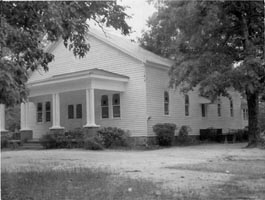
 1950s |
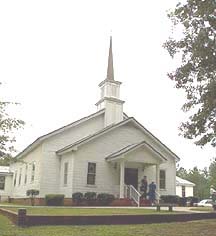 2002 |
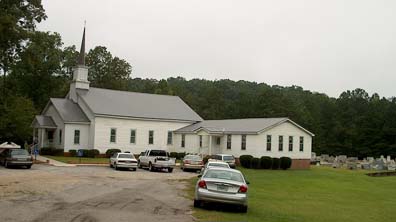 2003 |
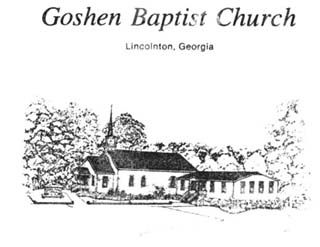 1987 |
 |
 |
Goshen Baptist Church
Lincoln County, GA
| 1950s |
2002 |
|
2003 |
1987 |
|
|
|
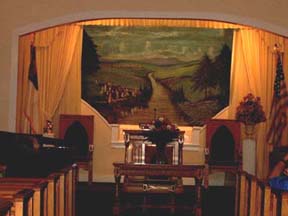
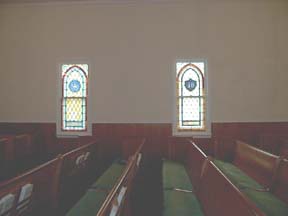
The picture on the top left was taken in sometime in the 1950s before the vestibule and fellowship hall were added. The one on the top right in 2002. Picture on 2nd row left taken August 2003. Left row right is a drawing done in 1987 for the bicentennial brochure. Artist is unknown. On the bottom is the beautiful mural and altar inside this lovely little church and the beautiful stained glass windows.
Taken from the bicentennial brochure, 1987 by Goshen Baptist Church during its 200th year celebration.
Let us try to picture this small portion of the state of Georgia, known as Lincoln County, as it may have been some two hundred and more years ago. This area and its communities were primitive and fraught with many hazards. The local citizens probably still lived in close proximity to the Indians. Of necessity due to their isolation, these settlers had to be self-sufficient. These early pioneers by virtue of living almost as one with nature were by their circumstances, devout, God-fearing people. They had ventured to settle in this wilderness of raw land with little to sustain them except their faith in God, and their own strength and determination. They were here to build a new life for themselves; a free life in a new country.
From their deep faith in God and His divine protection and guidance, these early settlers of Lincoln County, Georgia, joined together to form and constitute a House of Worship where they could share their faith and fellowship with other like-minded neighbors. Therefore, in 1787, according to Robinson's History of the Georgia Baptist Association, "Goshen Church, Lincoln County, was constituted. It was located two miles east of Goshen and called Soap Creek until 1793, then Rocky Spring. The name was finally changed to Goshen in 1817."
Samuel and Nancy Davis made a gift of one and one fourth acres of land to the commissioners of Goshen to build a meeting house on July 16, 1816. To see a transcription of the actual deed, click here. To see the copy of the actual deed, click here. Please be patient as they will take some time to load. You will have to use your back button to return here as there are no return buttons on the pictures.
Survival for our forefathers in this area and growth of the community demanded long, hard, grueling hours of work such as we can only imagine. Communication, even with a nearest neighbor, of necessity, was limited most likely to those times when the community gathered for worship. It follows then, that the first meeting house, shared by three denominations, was more than a House of Worship. It was the hub of the community. It was a place for neighbors to meet and share the news which had been garnered here and there, some from infrequent travelers or peddlers. It was a focal point for the dissemination of news as well as social activities with neighbors and friends. It was here that the young people could meet and form attachments which resulted in marriages and the founding of new homes and families.
Remember, this was not a wealthy area. A meeting house was sorely needed, but the citizens were not numerous enough nor wealthy enough to provide separate meeting houses for Baptists, Methodists and Presbyterians living in the area. As a good example of true Christian fellowship and cooperation, around 1810 the Baptists, Methodists and Presbyterians in a joint undertaking, built a House of Worship one-fourth mile from Goshen, all using the same building for a time. (We now know that the land was given for this meeting house in 1816 by Samuel Davis and his wife Nancy.)
Then, in 1835 the Baptists built themselves a Meeting House or Church. The structure of 1835 is now the sanctuary of present day Goshen Baptist Church. The sanctuary was built of original forest pine for the most part and its sills and sleepers, sixty feet in length, were hewn from the same kind of pine with the axe prints of its builders plainly visible. Its rafters are of the same material, eight by eight and twenty-seven feet long. Its doors were durably made, their hinges being homemade in such a manner as to enable the doors to be lifted out readily and to be set aside at will.
We are fortunate here at Goshen that early Church Minutes dating back to 1802 were found and are preserved. From these and other sources emerge a picture of our forefathers that sheds much light on the early days of this church which due to patience, perseverance and service of its members through the years still survives as a viable House of Worship.
In the antebellum days, Goshen Baptist Church, as with practically all of the churches of the day, admitted both whites and blacks to its membership. The records show that on the 12th day of September 1863 the membership consisted of Whites: 24; Blacks: 117. The rules governing church discipline in its earliest days were not only rigid as compared to present day church discipline, but were faithfully enforced. Character, honesty, truthfulness and loyalty were traits its members were required to have. In 1802 the church had eleven rules. That these rules were strictly enforced is evidenced by the fact that the church minutes show that from July 1803 to June 1867, at least twenty-three (possible thirty-two) whites and ninety-five blacks were excluded from the membership of the church. The grounds generally alleged, were immorality, lying, stealing and failure to live up to the rules of the church, such as church attendance, failure to observe notices to attend, etc. It was plain that the early church fathers did not countenance disloyalty either to God or to their church.
There are records of charges being brought by black members against other black members of the church. When a black member was excluded, the minutes often states that he was "excommunicated." In many instances the minutes bear record of a brother who has been excluded coming forward and making satisfactory acknowledgments to the church and of his being restored to the fellowship of the church. Throughout these records there runs a beautiful simplicity and sincerity coupled with an evident loyalty to God, to church and to principle of character which are inspiring.
Most of the leaders of the church were slave owners and they apparently made a sincere effort to improve the morals of the blacks, although this effort may have been in conflict with their own financial interests. The church insisted that the blacks comply with the same moral rules, including marriage that were imposed on the white members although the State did not recognize Negro marriages. In the minutes of June 10, 1865 we find the first intimation that the black members are beginning to leave the church. "A complaint was made against colored members for leaving their church. On motion and second, a committee consisting of the brethren: Dr. J. S. Lane, F.M. Wright, John Brown, P.W. Sale and H.M. Sale to ascertain how many colored members have left their owners, the circumstances under which they left," etc. The Minutes of Conference of the 14th of September 1867 record the last mention of colored members. It is not known just when Ebenezer Baptist Church for blacks was founded, but it is know as the "daughter" church of Goshen Baptist Church and was organized by those black members leaving Goshen. We can assume that it was probably organized sometime during the time frame of 1865 to 1867.
Over the years the faithful members of Goshen Baptist Church have made many improvements to their church building. In the 1940s the first addition, the pulpit alcove and two rooms were added to the rear of the original building, with Mr. Walter C. Martin, builder. Later, in 1959, Mr. Harry Murray and his son-in-law, Mr. George Wright, were contracted to build three rooms and a hallway behind this. In 1962, the baptistry was built by Mr. Hawes Drinkard and Mr. Wayne Chafin, members and deacons of the church. An artist was commissioned by the church to paint the mural over the baptistry. During this time, in 1964, the church hired Mr. Walter Cox to construct two rest rooms and a nursery. During the time of building the baptistry and the rest rooms a well was dug and a pump installed to provide the church with the necessary plumbing. Then in the mid 1960s, a pastor's study and a kitchen were added, followed in 1976 by the building of the fellowship hall. In 1980 the last additions to the church building, the porch, foyer and steeple were added. These last additions were erected in memory of Mrs. Ruby Drinkard Cullars by her daughters, Mrs. Frances Cullars Prater and Mrs. Peggy Cullars Guillebeau. These were dedicated in 1981. The most modern equipment to be installed is the public address system, installed and given to the church by the late Thomas B. Parks, a deacon. This system saw its first usage on Sunday, the 24th of October 1982.
As you walk through this beautiful church, you will note many stained glass memorial windows, all contributed to the church by families as memorials to loved ones. Most of the furnishings have also been contributed in the same manner. While you stroll around you will notice many memorial places identifying those items which have been placed here to honor those people who have been so faithful and loyal to Goshen Baptist Church. More than that, you see here the results of 200 years of God's people rendering to Him patient, persevering service.
Minutes of Goshen Baptist Church 1802-1869
The badly worn and faded minutes of Goshen Baptist Church 1802-1869 were found by Mr. G. E. Norman in the drawer of a table that had been abandoned and was put out in the weather. But for this fortunate discovery, these minutes would probably have been lost as have those prior to 1802 and subsequent to 1869.
Mr. J. Edd Hill read the minutes and realized that they were important to preserve. In order that this valuable record might be made available to everyone, he obtained permission from Mr. Norman to take the manuscript to Decatur, GA., his home, for typing. The two volumes of minutes were later microfilmed by the Georgia Department of Archives. Copies of this microfilm are available through inter-library loan from Georgia Baptist Historical Collection, Stetson Memorial Library, Mercer University, Macon, GA. 31207.