John L (Long John) Whidden
By Spessard Stone
South Florida in its pioneer days, like the "Wild West," had a wide-open
range with a number of infamous outlaws, one of whom was John L.
Whidden, commonly known as "Long John" Whidden.
A member of the prominent Whidden family, John L. Whidden was born ca.
1838 in Florida, probably Levy County. He was a son of William and
Lucinda Whidden. Early Hillsborough County, Florida records of
guardianship show that on January 11, 1855 James
Whidden, Sr. and
others petitioned that James Whidden, Jr. be appointed as guardian of
John, William, Mary, James, and George
W. Whidden,
"minor heirs of Lucinda Whidden, late of said county." On July 29, 1859
James L. Whidden, Jr., guardian of James and George W. Whidden, reported
35 head of cattle belonging to the estate. On September 26, 1859,
however, James and George W. Whidden, minor children of William Whidden,
citing the failure of James Whidden Sr. to perform his duty, requested
that their brother, John Whidden, be appointed their guardian.
Thus orphaned with the care of his siblings, John L. early learned the
old saying, "Life isn't always fair." How John was to react, however,
was to set him apart from other members of his clan and the
community-at-large.
During the Third Seminole War, John enlisted as a private in Capt. Leroy
G. Lesley's Company. Here John L. first began to evidence that
nonconformist conduct which would later lead to his downfall. Capt.
Lesley,
who was also a Methodist minister in the Old Testament warrior
tradition, on November 25, 1857 requested that Private Whidden be
discharged for disobedience and insolence and he was drummed out of
service.
John T. Lesley of Tampa, son of Capt. Leroy G. Lesley, in May 1904
declared of John, “Whidden known as Cutthroat John and his brother
William Whidden with another man did desert the company at Fort Meade
when the company was ordered to the Big Cypress..."
John T. Lesley on June 4, 1910 further averred:
"This John Whidden who had a brother William deserted together with his
brother William. We were stationed at Fort Meade and were ordered to go
to the Everglades in the interior of the state and they John Whidden and
his brother William said they would not go and were put under guard.
They then promised to go with us but when we started they were missing.
At this time this John Whidden and his brother William were members of
my father's company."
It appeared, however, that John was ready to settle down from his errant
ways as on January 14, 1858 he took as his bride 17-year-old Artemissa
Driggers. It seemed only an aberration when he in April was charged with
"willfully marking the calf of another." His mavericking was settled,
and John and his wife started anew at Fort Hartsuff.
The Whiddens were enumerated in household 34/34 in the Fort Hartsuff
area (now Wauchula) in the 1860 census of Manatee County, dated June 11.
Living with John, 22, and Artemissa, 19, besides their one-year-old son,
William, and one-month son, James, were John's 18-year-old brother,
James, and 16-year-old brother, George W. Neighbors included the
families of: Daniel Douglas, Isaiah Smith, and Ann Driggers.
During the Civil War, John enlisted as a private at Key West on December
8, 1863 in Company
A, Second Florida Cavalry, United States Army.
Company records described him as a refugee from the Confederacy, born
1835 Levy Co., 6 feet, with blue eyes, light hair & fair skin,
occupation, farmer. He was mustered out November 29, 1865 at
Tallahassee.
After the war, he settled near Fort Ogden, where he resumed his
livelihood as a farmer/stockman.
1869 found John again in trouble with the law. In May 1869, he was
charged with larceny. Owen R. Blount and David D. Whidden became his
sureties, which action they would later regret when on November 11, 1872
John L. was declared in default, and they were ordered by the state to
pay the recognizances.
While in Manatee County court, John L. burned his bridges with his
religious neighbors when on May 7, 1869 he filed an affidavit in which
he alleged: "...that on or about the third day of April 1869 one Wm.
P. McEwen did
create a disturbance at a place of worship in the vicinity of Fort Ogden
-- by loud and abusive language addressed to the deponent, and by
threatening and drawing a weapon upon him..." Wm. P. McEwen was the Rev.
William Penn McEwen, a beloved circuit-riding Methodist minister. No
further legal action could be found on the allegation.
On March 7, 1870, Frank Griffin gave a deposition before John
Bartholf,
Clerk of the Circuit Court of Manatee County, in which he charged that
on February 7 in the vicinity of Fort Ogden he was "set upon without
cause, pretext or provocation by one F.
C. M. Boggess,
John L. Whidden, Joseph Brooker and David Whidden, and assaulted and
pursued with deadly weapons...with threats to kill him..." A cowhunter
employed by Simeon Hollingsworth, Griffin is believed to have been an
ex-slave.
Whidden next added manslaughter to his crimes. Francis
A. Ivey,
who'd served with John in Company A, Second Florida Cavalry, lived in
Fort Ogden township with his wife, Barbary, and two daughters, Mary
Frances and Caroline. The nickname of "Long John" was first applied in
print to Whidden in the Florida
Peninsular of
June 29, 1870:
"Man Killed--Francis A. Ivey was killed by John Whidden (Long John) near
Fort Myers, Monroe county, not long since, under the following
circumstances as we have heard them: The parties were minding a drove of
beef cattle, and fell out as to which had control of them.-- High words
ensued; Ivey advanced upon Whidden, threw sticks and trash in Whidden's
face, whereupon Whidden, after repeatedly warning Ivey to stand off,
drew his knife and stabbed him in the abdomen. Ivey lived about a week
after he was stabbed. Whidden had not been arrested up to latest dates."
Ivey died on June 11, 1870. Long John fled and was never apparently
arrested.
Long John Whidden was soon heard of again when the Florida
Peninsular of
October 5, 1870 chronicled a further altercation in Manatee County: "We
learn that a difficulty occurred between a young man named Parish and a
man called Long John, in which the long gentleman was stabbed. The
wounds inflicted upon Long John are supposed to be mortal, and Parish
has left the county." Described "as almost a giant in size and in
appearance as strong as Hercules," Long John arose from his "death-bed"
and fled the (for him) hostile environment for Sumter County.
Trouble and Long John were synonymous. On August 7, 1878 in Manatee
County, Jackson Prine was killed with John being the suspect. Frances
Prine, the widow, testified: "The said Prine was killed on the 7th of
Aug. 1878 at about dark in Manatee Co., Fla. There was no one present
except Prine, Myself and Baby and my son. John Whidden was lying on the
bed, sick. Prine and me were out in the shed. I heard the report of a
gun, and Prine fell at my feet, on his face, he died immediately and if
he ever spoke any thing I never heard it and at the time the gun fired
he was whipping me with a strop of leather. I heard John get off the
bed, and then he caught me by my right arm and asked me what was the
matter."
The Whiddens were enumerated in the 1880 census of Sumter County. Listed
in the household, besides John, age 44, and his wife Mary, 21, were
seven children, Wm. F., 18 [?]; James, 18; Ellen E. 16; Artimien, 12;
John M., 9; Mary H., 4; Jessie F. (son), 2.
Long John and his son, Irvin, in May 1882, provoked a fight that led to
murder of Thomas W. "Tom" Jones, which placed them beyond the pale of
the law to become outlaws with a bounty on Long John.
The Florida Daily Times of
Sunday, May 21, 1882 reported:
"Tampa, May 16-
"The news reached Tampa Monday of the murder of Mr. Tom Jones, formerly
a citizen here, in Webster, Sumter County, last week. The circumstances
appear to be about as follows:
"Two rowdies came to the mill Mr. Jones was employed at, and started the
machinery of the mill when the workmen were at their dinner. Jones
immediately stopped the moving machinery, and ordered the men to desist
and leave. The rowdies then knocked Tom down and left. Tom, being a
small man, of course, could not defend himself against two giant,
drunken bullies.
"At the close of the day's labor, Jones returned to his boarding house,
and there he encountered the men who so cowardily assaulted him at the
mill. However, being of a peaceful turn of mind, he overlooked the
occurrence of the morning and let the matter drop. At the supper table
the two rowdies commenced again to renew the quarrel and threw a plate
at Jones and cut him up pretty badly. Even then Jones would not fight,
and went down to the store of the mill-owner. He did this in order to
keep out of their way. He was fearful the men might follow him still, so
he took his gun and loaded it.
"To protect his life he loaded his gun with buckshot. Soon his
tormentors followed him, this time on trouble bent. Jones called to them
to leave, but they still advanced, threatening him. He fired a load at
one, and then another load at the other. The loads were well aimed, but
a lack of powder made them ineffective. The ruffians advance and shot
him down. He was killed at the first fire. This was not enough. The
murderers advanced and emptied their six shooters in the dead body of
their victim and then coolly walked off."
Declaring they would not be taken alive, Long John, now called "Black
John," and Irvin eluded capture by a sheriff's posse to flee to the Ten
Thousand Islands. There they were joined by others of the family and
secreted themselves on Ramrod Key, opposite Torch Key. An enticing
$1,000 reward was offered for Black John.
In 1888, H. H. Herndon, deputy sheriff of Sumter County, having learned
of Whidden's hideout, journeyed to Key West. Posing as desirous of
purchasing land somewhere on the coast to engage in the breeding of
sheep, goats, and poultry for the Key West market, Herndon engineered a
sting, maneuvering Long John to come to Torch Key to discuss selling his
improvement on Ramrod Key and with the assistance of a Mr. Johnson and
Garry Nile captured the fugitive, but only after a desperate struggle
with Whidden and the seizure of Long John's trusty rifle from his
twelve-year-old son who was in the act of firing when Johnson snatched
the rifle.
Then Herndon went to Ramrod Key and arrested Irvin, who offered no
resistance. Thus, after three or four weeks, the lawman had finally
snared his prey. On March 31, 1888, he arrived at Key West with his
prisoners and from there they were sent via mail boat to Tampa and then
to the Sumterville jail. Left behind at Ramrod Key were Long John's wife
and three children.
Sumter County Sheriff Chapman subsequently carried Long John to
Gainesville in April where he was imprisoned awaiting the next session
of the circuit court. Irvin, deemed less dangerous, was left confined in
the Sumterville jail.
The Lakeland Cracker,
reprinted in the Weekly
News-Herald of
April 5, 1888, noted that beside the Jones murder, John L. had also
eluded the law in another murder case, that of Frank Ivy [sic], "Ivy had
killed a brother of Whidden, and was in turn was killed by Whidden."
On March 15, 1889, John Whidden for the murder of Tom Jones was
sentenced to life imprisonment. The 24-year-old Irvin also received a
life sentence. John L. "Long John" Whidden died in prison on November
11, 1891. Irvin, due to his youth when the murder occurred, drew
sympathy from a number of prominent citizens in Sumterville, including
the jury who convicted him, and a petition was circulated for his
pardon. On March 15, 1897, Irvin was released. Thus did mercy season
justice.
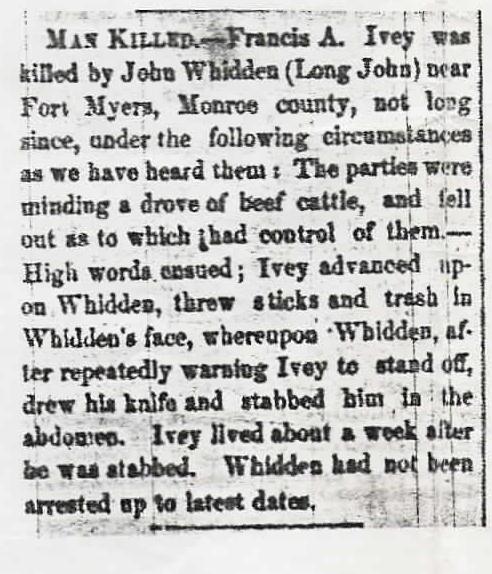
Florida Peninsular, June 29, 1870, p.
2, col. 3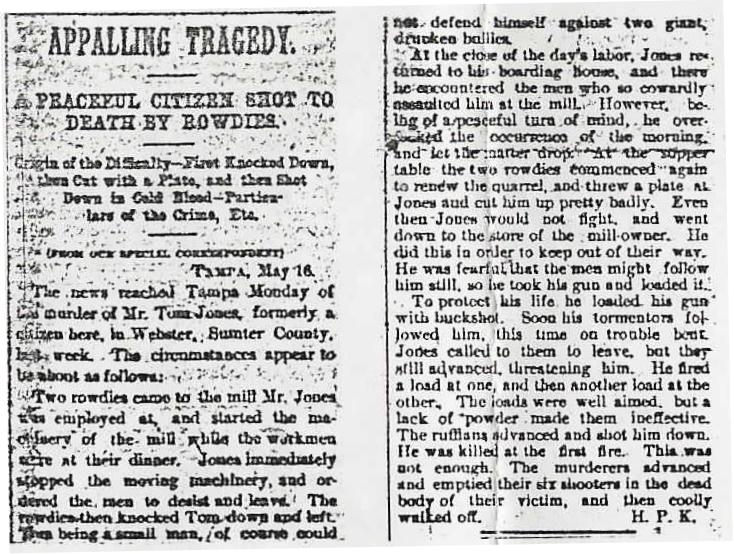
Florida
Daily Times, May 21, 1882, p. 1
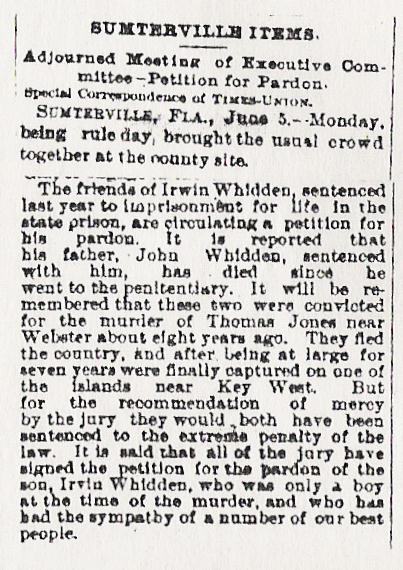
Florida Times-Union, June 9, 1890,
p. 1, col. 4
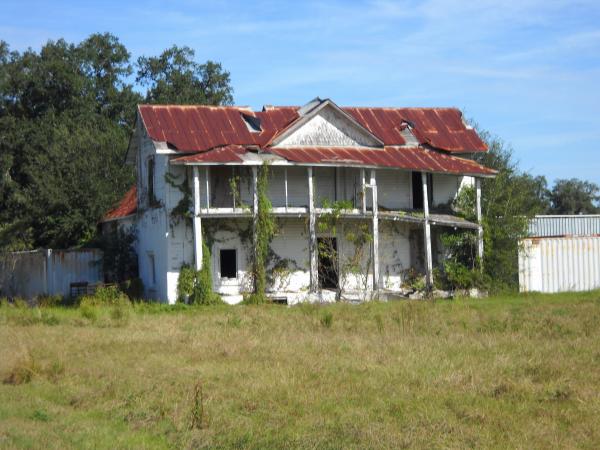 On November 5, 2009, Ken Murphy emailed this photo with the comment:
This is the Collins house in Webster, a boarding house built around
1880. Originally, it sat about 300 yards from the saw mill. It could be
the boarding house where Long John was staying when he shot and killed
Thomas Jones. No way to confirm it though. The owner had never heard of
the story. Ken M.
On November 5, 2009, Ken Murphy emailed this photo with the comment:
This is the Collins house in Webster, a boarding house built around
1880. Originally, it sat about 300 yards from the saw mill. It could be
the boarding house where Long John was staying when he shot and killed
Thomas Jones. No way to confirm it though. The owner had never heard of
the story. Ken M.
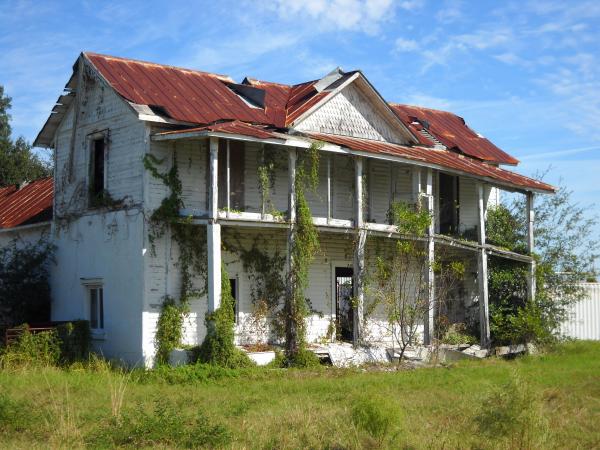 On November 5, 2009, Ken Murphy emailed this photo with the comment:
This is the Collins house in Webster, a boarding house built around
1880. Originally, it sat about 300 yards from the saw mill. It could be
the boarding house where Long John was staying when he shot and killed
Thomas Jones. No way to confirm it though. The owner had never heard of
the story. Ken M.
On November 5, 2009, Ken Murphy emailed this photo with the comment:
This is the Collins house in Webster, a boarding house built around
1880. Originally, it sat about 300 yards from the saw mill. It could be
the boarding house where Long John was staying when he shot and killed
Thomas Jones. No way to confirm it though. The owner had never heard of
the story. Ken M.
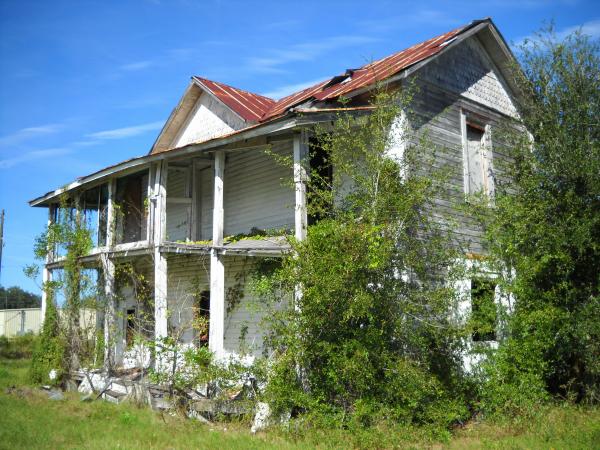 On November 5, 2009, Ken Murphy emailed this photo with the comment:
�This is the Collins house in Webster, a boarding house built around
1880. Originally, it sat about 300 yards from the saw mill. It could be
the boarding house where Long John was staying when he shot and killed
Thomas Jones. No way to confirm it though. The owner had never heard of
the story. Ken M.
On November 5, 2009, Ken Murphy emailed this photo with the comment:
�This is the Collins house in Webster, a boarding house built around
1880. Originally, it sat about 300 yards from the saw mill. It could be
the boarding house where Long John was staying when he shot and killed
Thomas Jones. No way to confirm it though. The owner had never heard of
the story. Ken M.
References: Canter Brown, Jr. provided copies of most of the research
data cited. See also Brown, Florida's Peace River
Frontier, pp 205, 408 (Frank Griffin), 1991; "Hillsborough County:
Old Guardianship," South Florida Pioneers 17/18
(July/Oct. 1978); L. G. Lesley to G. W. Hazzard, November 25, 1857, Ft.
Meade, Roll # 8, M-1084, National Archives; Indian war pension
application of John Whidden (1839-1926); Hillsborough County, County
Judge, General Index to Marriage Licenses, Males, 1846-1935, Book
A, p. 45, Florida Archives. Note of March 26, 2011: My apologies are
extended about just now including the house photos. My Embarq emails had
been going into a "black hole" since July 2009. I just recovered the
emails.
This profile is adapted from The
Herald-Advocate, January 9, 1992 and The Sunland
Tribune November 1992 (18), pp. 80-81.
Contact Us
If you have questions, contributions, or problems with this site, email:
Coordinator -
AVAILABLE FOR ADOPTION
State Coordinator:
Paula Perkins
Asst. State Coordinator:
Rebecca Maloney
Questions or Comments?
If you have questions or problems with this site, email the County Coordinator. Please to not ask for specfic research on
your family. I am unable to do your personal research. I do not live in Indiana and do not have access to additional records.


