Francis A Ivey
By Spessard Stone
Francis A. Ivey, a pioneer settler of Fort Meade and Fort Ogden,
Florida, was a veteran of the Third Seminole War and Civil War, whose
service in the latter and life were marred with controversy.
Francis A. Ivey was born in 1829 in Alachua County, Florida. During the
war with Mexico, Francis A. Ivey of Newnanville was mustered in at Fort
Brooke in Fisher's
Company on
January 9, 1848 and mustered out on June 30 1848. All the company's
service was at Fort Brooke. In the 1850 census of Hillsborough County,
Florida. he was was recorded with Isam and Martha Jane Dees in the Pease
Creek settlement in the 1850 census.
On November 4, 1850, at near now Plant City, he married Barbara E.
"Barbary" Underhill, born ca. 1831, daughter of Joseph and Nancy
(Hilliard) Underhill.
A farmer and cattleman, Francis on April 12, 1853 registered his mark
and brand: crop and two splits in one ear, split in the other, brand
IVY. By 1855-56, the Iveys were living west of Fort Meade.
During the Third Seminole War, Francis served from January 3, to August
20, 1856 in Capt. William B. Hooker's Company and was mustered out as a
sergeant.
The 1860 census of Hillsborough County enumerated "Frank" and "Barber"
and their daughters, Mary and Caroline, at Fort Meade. Frank had no
slaves. Living with the Iveys was Edward Willard, a twenty-year-old
Georgia native.
During the Civil War, Francis first served the Confederate cause. His
exploits included helping to close the lighthouses at Jupiter and Cape
Florida as their beacons were useful to the navy off the coast. The
former assistant lighthouse keeper at Jupiter, A. Oswald Lang, and his
men first evicted Lang's superior at Jupiter and disassembled the
lighthouse. Next, they by a ruse captured the two loyal lightkeepers at
Cape Florida, removed the lamps and burners and smashed the lens. At a
meeting of the citizens of Indian River, Brevard County, held August 28,
1861, Cpt. James Paine, Francis Ivey, Oswald Lang and John Whitton were
thanked for their "prompt action in putting out the lights of Jubeter
and Cape Florida."
At Fort Myers on June 4, 1864, Francis enlisted in Company A, Second
Florida Cavalry, U. S. Army. Capt. Crane exulted, "In the ranks of our
guard to-day stands the greatest Guerilla extant, 'Frank Ivey' the
despoiler of the whole Eastern Coast of Florida - he is obedient, & I
expect to make him a corporal." Capt.
James D. Green of
Company B had opposed the enlistment and rejected him from his company
due to disloyalty. Nevertheless, Francis was promoted to 4th corporal on
June 17 and to 3rd corporal of Company A on September 15, 1864.
Lt. William McCullough of
Company A, formerly a Fort Meade neighbor of Ivey, on April 21, 1865,
after an altercation with Ivey, wrote Capt. Crane: "Francis A. Ivey, the
man you enlisted after you knew him to be a traitor to the government,
and that he was one of the very men who broke up lighthouses at
Keybisken and Jupiter. Besides you know he did kill White and McQuin,
all these facts you had at hand, and could prove the crimes against
him..."
Capt. Green further stated that Ivey and Sgt. Edwards of Company B had
been doing all they could for McCullough and his destruction and Capt.
Crane's "as he knew them to be rank rebs at heart."
From Key West on May 28, 1865, McCullough expounded to Jasper Dunbar,
his adopted son:
"I can give evidence against a man by the name of Ivey, a member of Co.
A, 2nd regiment, Florida cavalry...He is a grand rascal, and
imprisonment is too good for him.
"He has, at one time to my knowledge, stabbed one man, a soldier of the
U.S. army at Tampa, at another time shot at his brother-in-law, and
again at Fort Drum in Brevard County he killed Wm White by shooting him,
having placed himself in ambuscade, and as White approached, shot him -
leaving a wife and two little children, the oldest not two years old,
thirty miles to where the widow could get help and assistance, she being
in a forward state of pregnancy.
"Previously to his killing White, he also killed a man by the name of
McQuin, and tried to make it appear that White had done the deed - but
we all knew White to be better disposed, and then White could prove
where he was when the murder was done, and Ivey could not prove where he
was.
"This is the man that Major Weeks has protected against law and justice,
and the same man that broke up the light house at Keybisken Bay, Fla.
and threatened the men at the place with death if they had anything to
say about it, then proceeded to Jupiter and destroyed the lighthouse at
that point..."
No action was apparently taken and Corporal Ivey was mustered out
November 29, 1865 at Tallahassee. He was described as being 5'7," with
grey eyes, red hair, of light complexion, and by occupation a farmer.
After the war, the Ivey family moved to Fort Ogden in then Manatee
County. In 1868, Francis was Inspector of Marks & Brands for Manatee
County. On September 28, 1868, Assemblyman James D. Green, perhaps
showing the paucity of qualified Union men, recommended Francis be
appointed a county commissioner of Manatee County.
Francis A. Ivey was killed on June 11, 1870 by John
L. (Long John) Whidden.
(One source in error has 1871 for his death.)
The Florida Peninsular of
June 29, 1870 reported:
"Man Killed-Francis A. Ivey was killed by John Whidden (Long John) near
Fort Myers, Monroe county, not long since, under the following
circumstances as we have heard them: The parties were minding a drove of
beef cattle, and fell out as to which had control of them. High words
ensued; Ivey advanced upon Whidden, threw sticks and trash in Whidden's
face, whereupon Whidden, after repeatedly warning Ivey to stand off,
drew his knife and stabbed him in the abdomen. Ivey lived about a week
after he was stabbed. Whidden had not been arrested up to latest dates."
Long John Whidden, a son of William and Lucinda Whidden, was not,
apparently, prosecuted for Ivey's death. Perhaps it was seen as eye to
eye frontier justice as one report had Ivey had killed a brother of Long
John. Anyway, Long John died on November 11, 1891 in state prison where
he was serving a life sentence for the murder of a Sumter County man,
Tom Jones.
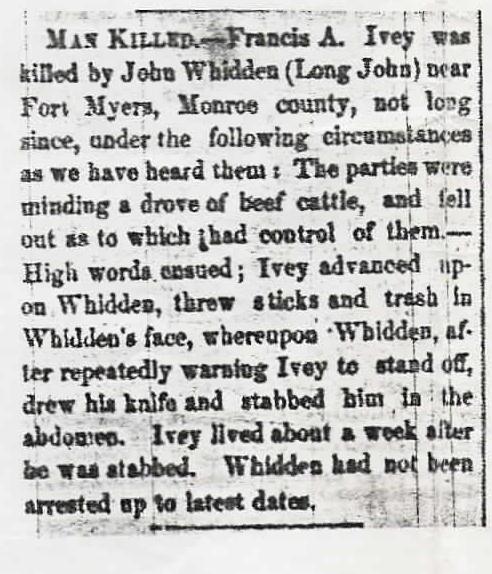
Florida Peninsular, June 29, 1870, p.
2, col. 3
In November of 1877, Barbara Ivey married James M. Thomas. James M.
Thomas, age 26(?), and Barbary Thomas, age 46, were enumerated in the
Pine Level region in the 1880 census of Manatee County. Joseph
Underhill, age 85, listed as "Soldier 1812," was a next household
neighbor.
James M. Thomas died February 27, 1906. Barbara Ivey
Thomas died November 28, 1914 and was buried in Lily Cemetery in Hardee
County, Florida.
Issue of Francis A. and Barbara (Underhill)
Ivey:
1. Mary Frances Ivey, born 1852; died 1942; married Feb. 9,
1871 James Arthur Albritton, son of Thomas H. and Frances (Waldron)
Albritton.
2. Caroline
Elizabeth Ivey, born September 11, 1854; died October 27, 1929;
married on Feb. 9, 1871 Oliver Asbury Albritton, son of Thomas H. and
Frances (Waldron) Albritton.
References not cited include:
Richard Livingston, "Francis A. Ivey 1829-1871," South
Florida Pioneers (April 1977); Canter Brown, Jr.,
Historian in Residence, Tampa Bay History Center; George E. Buker, Blockaders,
Refugees, & Contrabands, 1993.
This profile was adapted
from the author's article in The Herald-Advocate of
October 17, 1996.
See also:
Carrie
Ivey Albritton's Obituary from Union Church, Lily, Fla.
Contact Us
If you have questions, contributions, or problems with this site, email:
Coordinator -
AVAILABLE FOR ADOPTION
State Coordinator:
Paula Perkins
Asst. State Coordinator:
Rebecca Maloney
Questions or Comments?
If you have questions or problems with this site, email the County Coordinator. Please to not ask for specfic research on
your family. I am unable to do your personal research. I do not live in Indiana and do not have access to additional records.


